

Before and After: Conserving Portraits of a Noble Family
Authors: Anastasia Shteinert, Michael Perekrestov
Three once-faded portraits have just been brought back to life. These recently donated portraits, depicting members of the distinguished Olferiev family, have been carefully conserved thanks to the generosity of our supporters and the expertise of Nathan Sutton, paintings conservator at West Lake Art Conservation Center.
Each painting underwent a meticulous process, from flattening warped canvases to retouching lost paint and reviving their original frames. The result? A vivid glimpse into the lives of one of Russia’s noble lineages, whose roots trace back to the time of Ivan the Terrible. Not only did the conservation treatment bring back the paintings’ original vibrance, but also revealed the ghost of an earlier composition in one of the portraits.
The paintings were lovingly preserved by descendants of the Olferiev family, despite the hardships and challenges of emigre life. They were donated to the Russian History Museum last year by Anna Olferiev and Alexander Gontscharow, along with other artifacts and archival materials relating to the Olferiev family.
Here is the story behind the faces.
The Battle-Hardened General
Pavel Vasilievich Olferiev (1787–1864), born in Lopatino in the Saransk district, led a long and decorated military career that spanned the most turbulent decades of 19th-century Russia. He began his service in 1800 and graduated as a cornet in 1805, just in time to fight in major battles of the Napoleonic Wars, including Schöngrabern, Austerlitz, and Preussisch-Eylau. During the Patriotic War of 1812, he distinguished himself in combat, earning the Order of St. Anna, 3rd Class, and a promotion to rotmistr (captain).
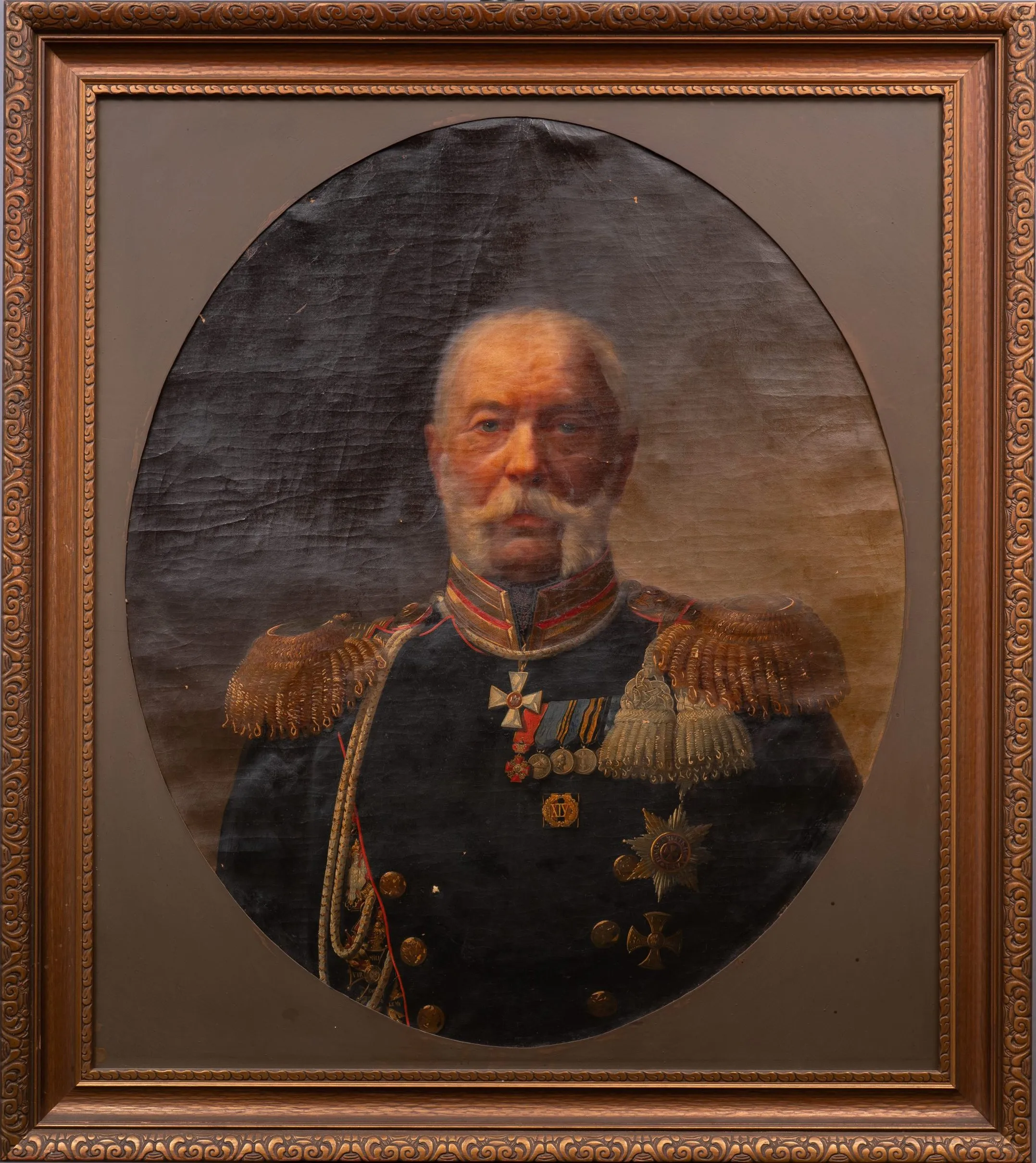
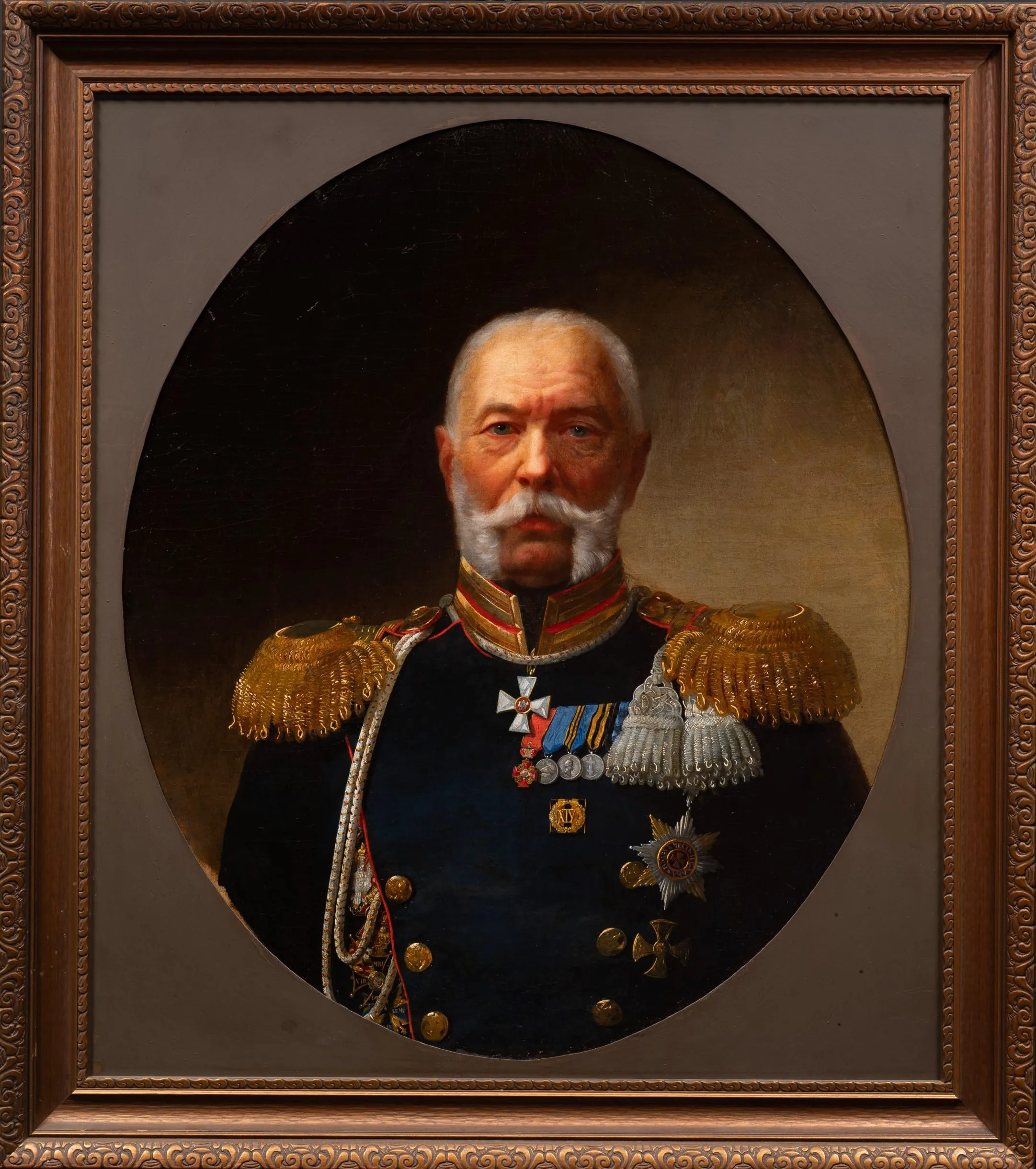
Olferiev continued to rise through the ranks during the 1813–1814 campaigns, fighting at Magdeburg, Leipzig, Saint-Dizier, and Breda, and earning promotions to major and then lieutenant colonel. In the following years, he commanded multiple regiments, saw action in the Russo-Turkish War (1828–1829), and played a role in suppressing the Polish uprising (1830–1831). In recognition of his service, he was promoted to General of Cavalry in 1851 and awarded the prestigious Order of St. Alexander Nevsky. During the Crimean War, he was entrusted with organizing local militias in the Chernigov province. He retired under Emperor Alexander II and died in 1864.
The portrait shows General Olferiev towards the end of his career, decorated with numerous orders, badges, and medals. Among them is the badge for forty-five years of unblemished service: the number 45 in Roman numerals on the orange and black ribbon of the Order of St. George.
As part of the recent conservation effort, the portrait of General Olferiev was carefully examined and documented. The conservator produced a detailed condition diagram, noting areas of damage that required stabilization and treatment.
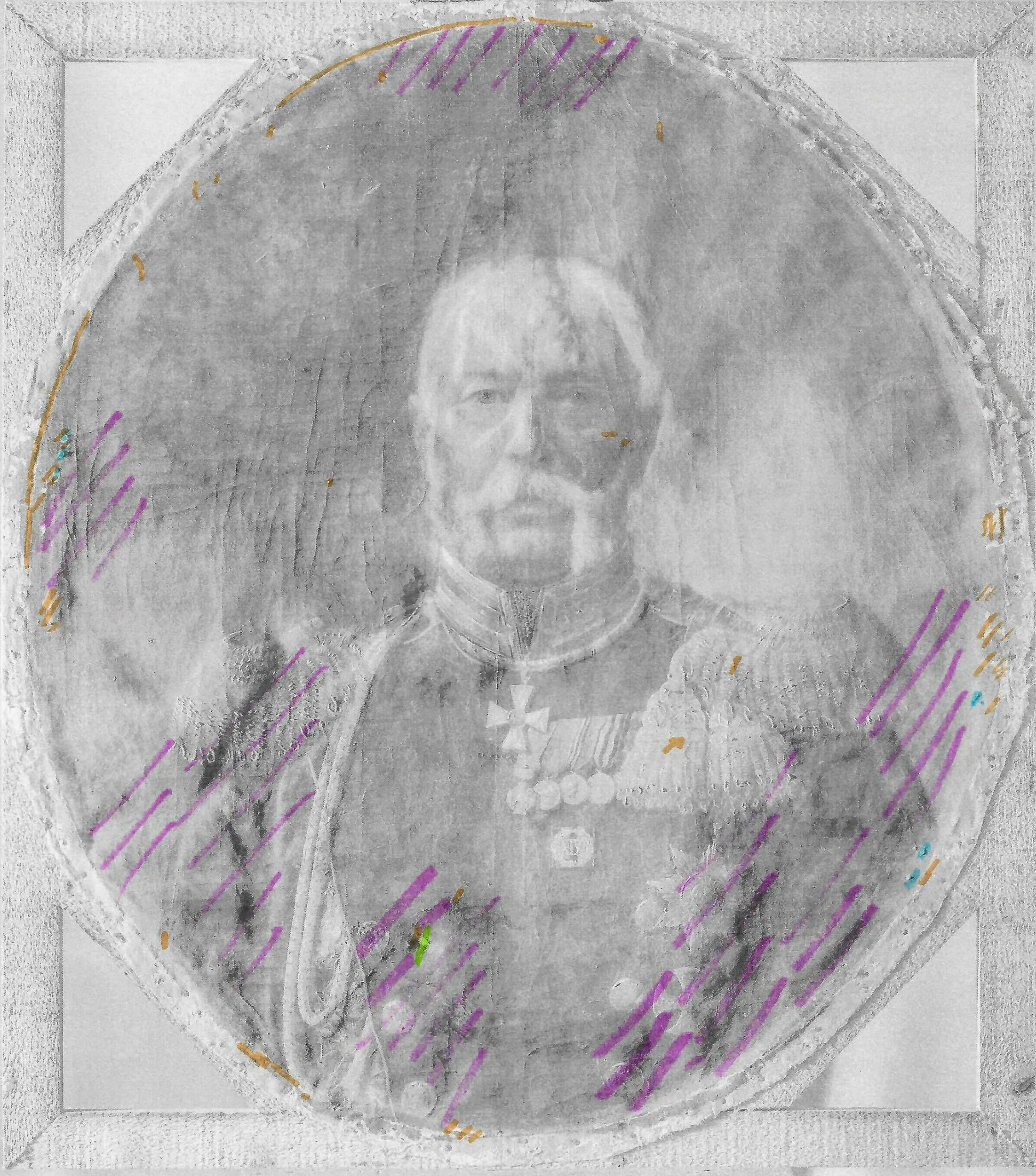
Condition before treatment. Orange indicates areas of paint loss; magenta indicates distortions in the canvas; green indicates a tear in the canvas
The conservation assessment included a cleaning test, revealing a dramatic difference between areas covered in aged varnish and those gently cleaned to reveal the original paint. The portrait’s surface was covered by a network of cracks, likely caused by prolonged exposure to high heat in less-than-ideal storage conditions.

Cleaning test
The Noblewoman and Matriarch
Sofia Vasilyevna Olferieva (née Obukhova, b. 1801) came from wealth and distinction in her own right. The daughter of Vasily Ivanovich Obukhov, a prominent Kazan landowner and brigadier, she married General Pavel Vasilyevich Olferiev, becoming part of one of Russia’s noble military families.
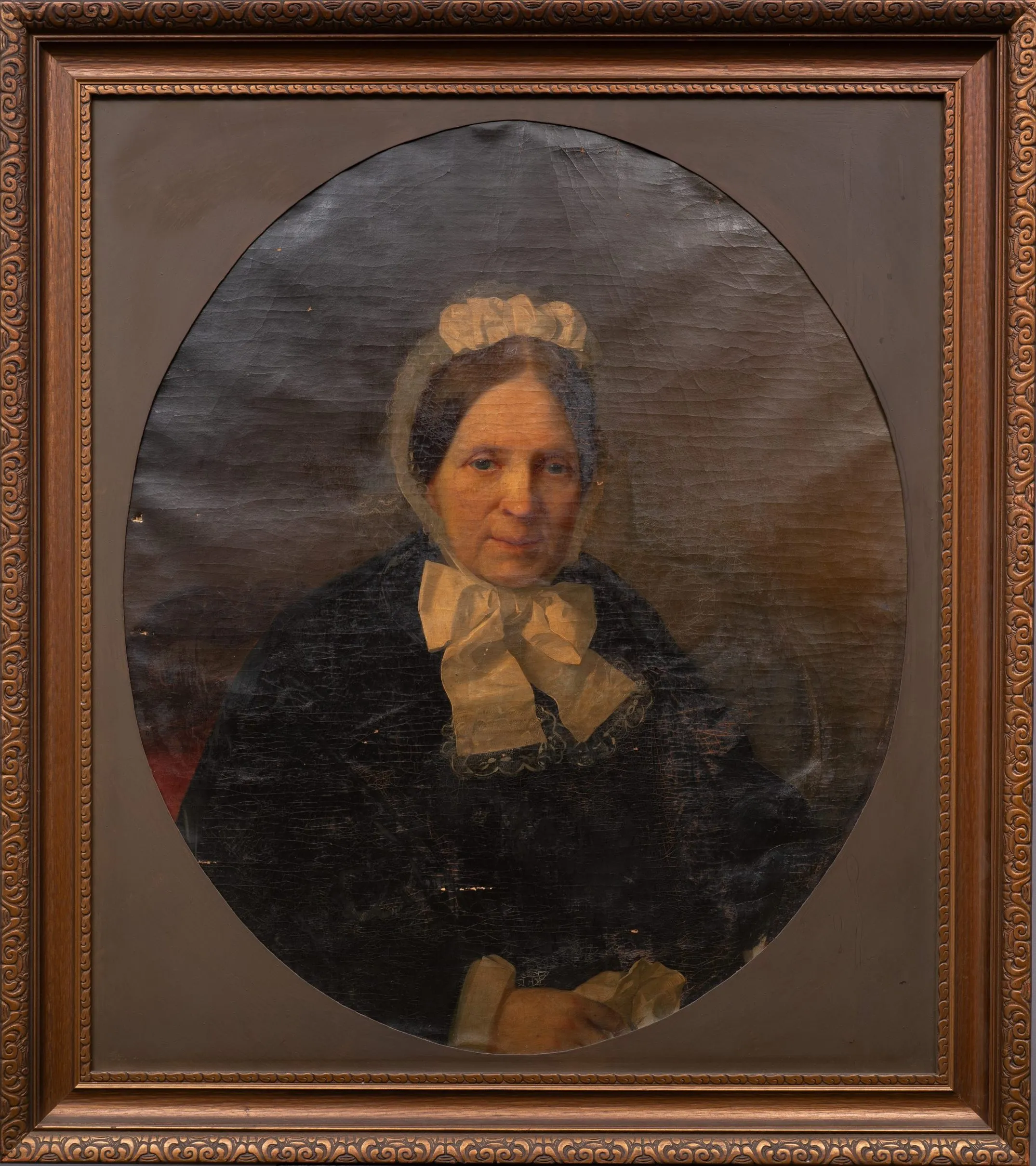
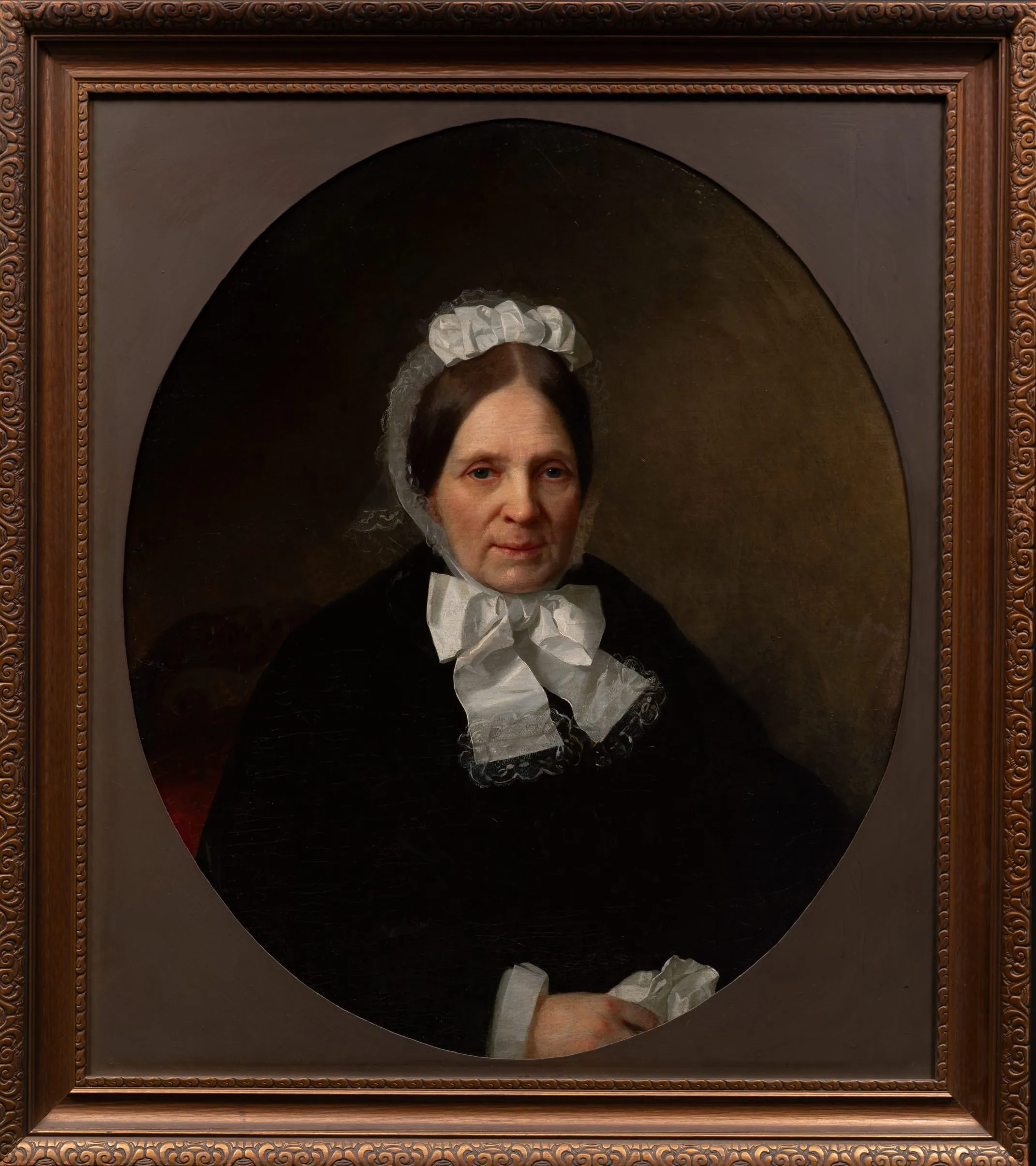
Pavel and Sofia had eleven children—four sons and seven daughters—whose marriages often reflected Pavel’s social circle, including families of his army comrades and neighboring gentry.
Following her husband’s death, Sofia became the head of the Olferiev estates. She inherited the family’s vast holdings in the Chernigov Governorate, comprising more than 700 serfs, and maintained a second estate in the Poltava Governorate with over 300. In total, she managed more than 1,100 serfs and approximately 10,800 acres of land.
The portrait’s condition diagram shows that over the years, the canvas had lost its original tension, with visible slackness and edge distortions under raking light. Two small tears had also formed near the perimeter.
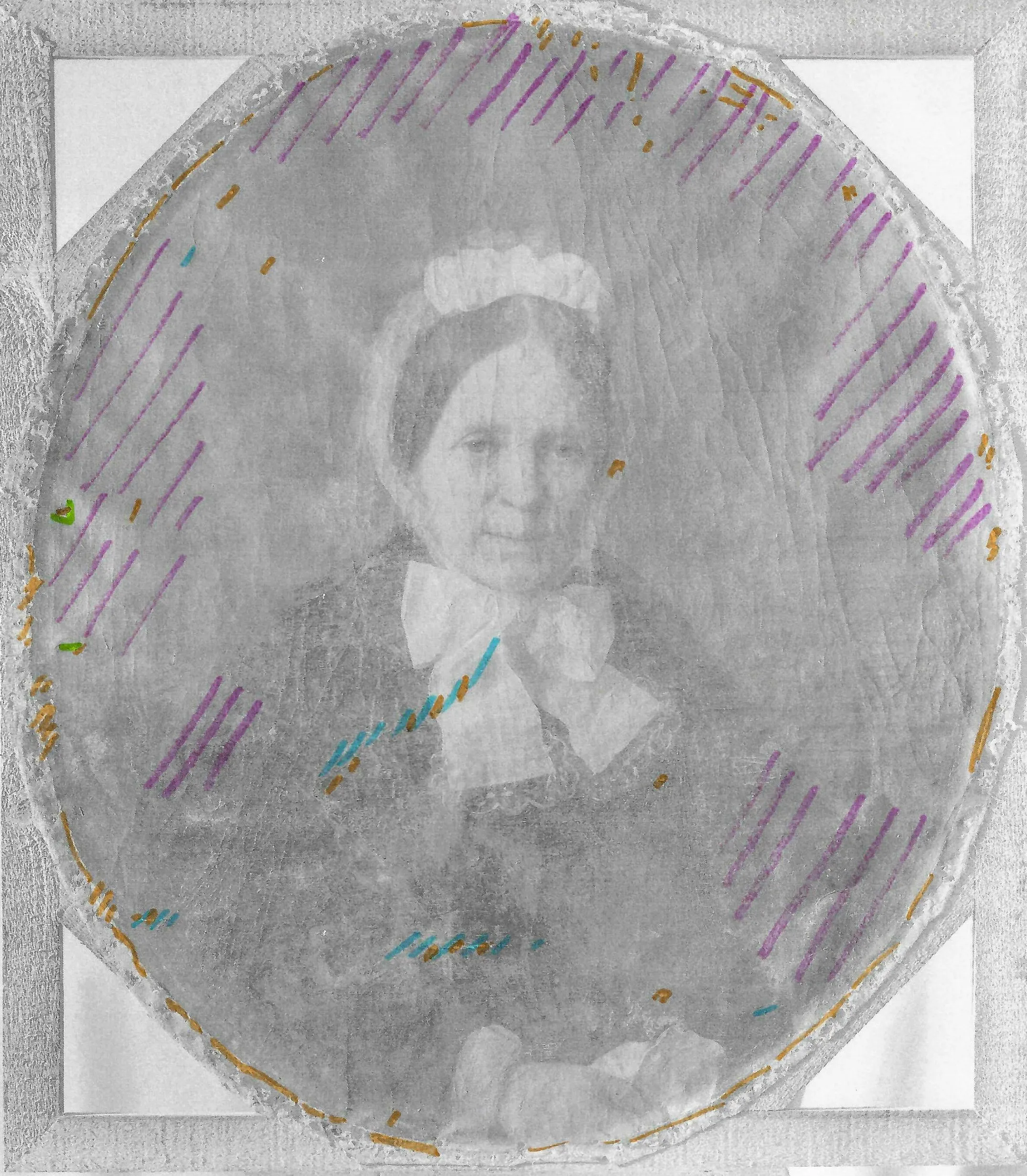
Condition before treatment. Orange indicates areas of paint loss; magenta indicates distortions in the canvas; green indicates tears/punctures in the canvas; blue indicates areas of insecure/lifting paint
During the conservation process, the portrait revealed a secret. Beneath the layers of overpaint are traces of an earlier composition that the artist later altered. In the first version, the woman’s left arm was raised gracefully near her face. The artist painted over it and repositioned both hands downward. In the picture below, you can see the faint outline of the original arm, now hidden beneath the later paint layer.

Kerensky’s Sister
Among the later descendants of Pavel Vasilyevich and Sofia Vasilyevna Olferiev was their grandson, Vasily Vasilyevich Olferiev (1874–1944), born in Geneva. Like many in his family, he pursued a career in public service, first fighting in the Russo-Japanese War (1904–1905), then joining the Russian Ministry of Foreign Affairs.
In 1904, Vasily married Anna Feodorovna Kerensky (1879–1946), a name that links the Olferievs to one of the most dramatic chapters in Russian history.
Anna was the sister of Alexander Kerensky, the head of Russia’s Provisional Government—the transitional regime that briefly held power after Nicholas II’s abdication in March of 1917 before being toppled by the Bolsheviks during the October Revolution.

Alexander Kerensky in 1917. Source: Wikipedia
Anna and Vasily met in Tashkent, drawn together by a shared love of music, painting, and theater. Anna acted in amateur performances, while Vasily designed stage sets and posters. Anna was actively engaged in volunteer work—she was a dedicated member of the Red Cross, earning a badge for her service in 1906.
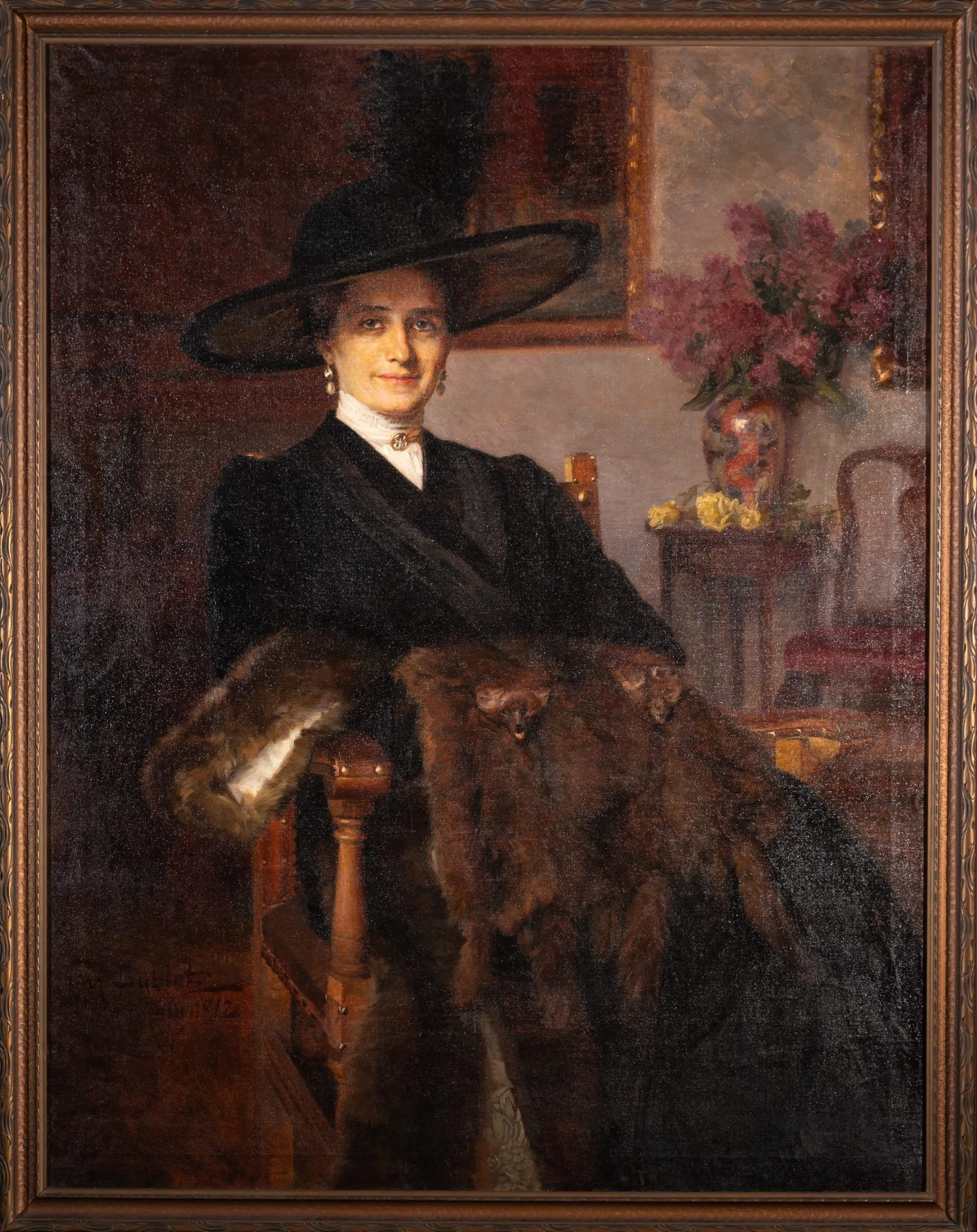
Unlike the other two conserved portraits, Anna’s is both signed and dated. It was painted in 1912 by Carl Bublitz, a German portraitist from Königsberg. The work not only captures Anna’s likeness, but also gives Bublitz an opportunity to showcase his skill in rendering a rich variety of textures—from the delicate fabrics of her costume and the shimmer of her jewelry to the soft fur draped across her lap and the details of furniture, flowers, and vase in the background. The date of the portrait aligns with Vasily Olferiev’s appointment as secretary of the Russian Consulate in Königsberg, where the couple lived until the outbreak of World War I.
The Russian Revolution and ensuing civil war scattered the Olferiev family. After 1920, Vasily emigrated first to Latvia, then to Germany, where he died in 1944. Anna and their two children took a different path, escaping through the Caucasus to Yugoslavia. Eventually, she and Vasily separated. Anna spent her final years in Zemun (present-day Serbia) with her daughter Maria and son Pavel.
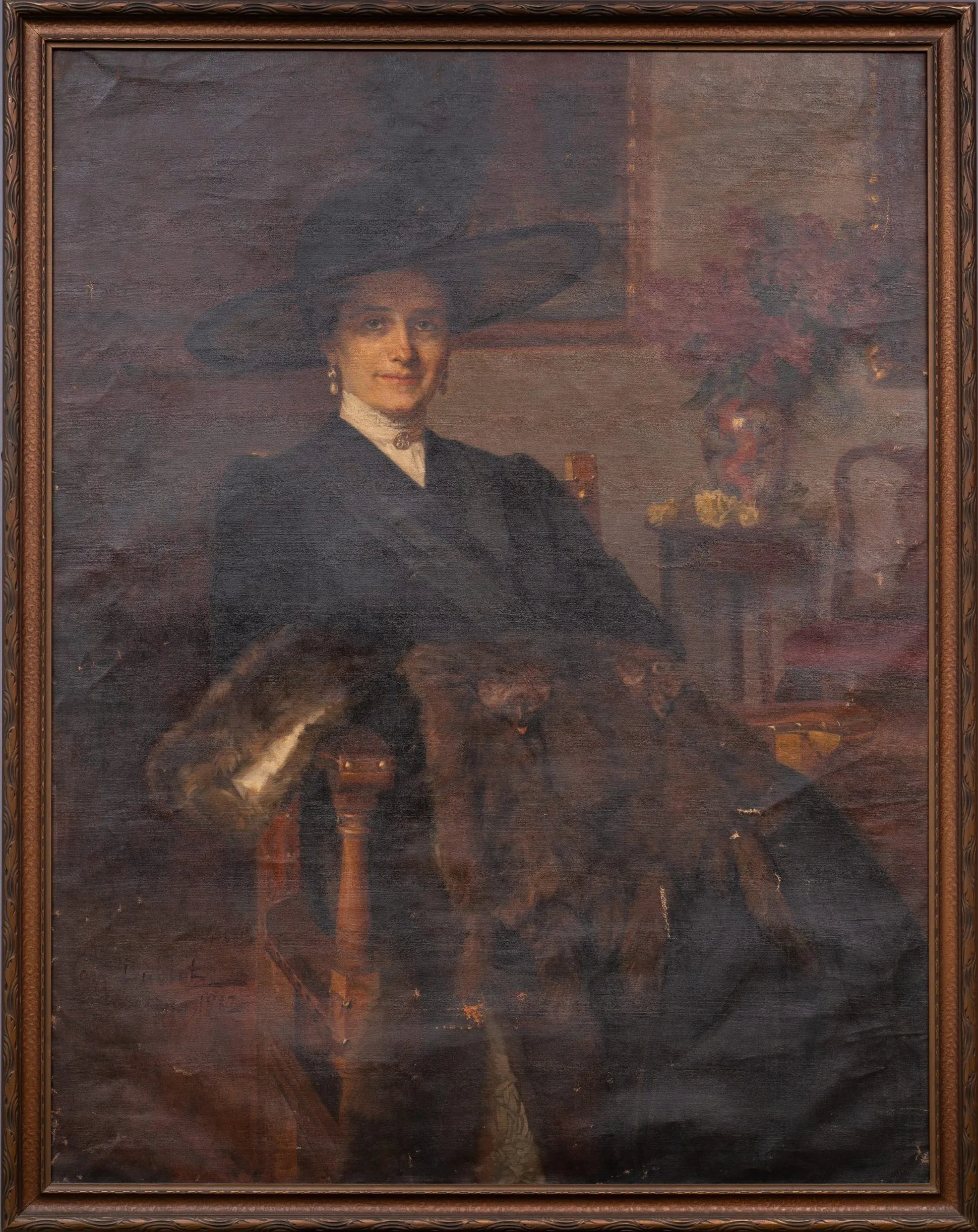
The portrait itself required significant conservation. The condition diagram reveals extensive areas of lifting paint and structural damage. A cleaning test strip shows the vibrancy hidden beneath layers of aged varnish and grime, restoring the image of a woman who witnessed the demise of an empire.
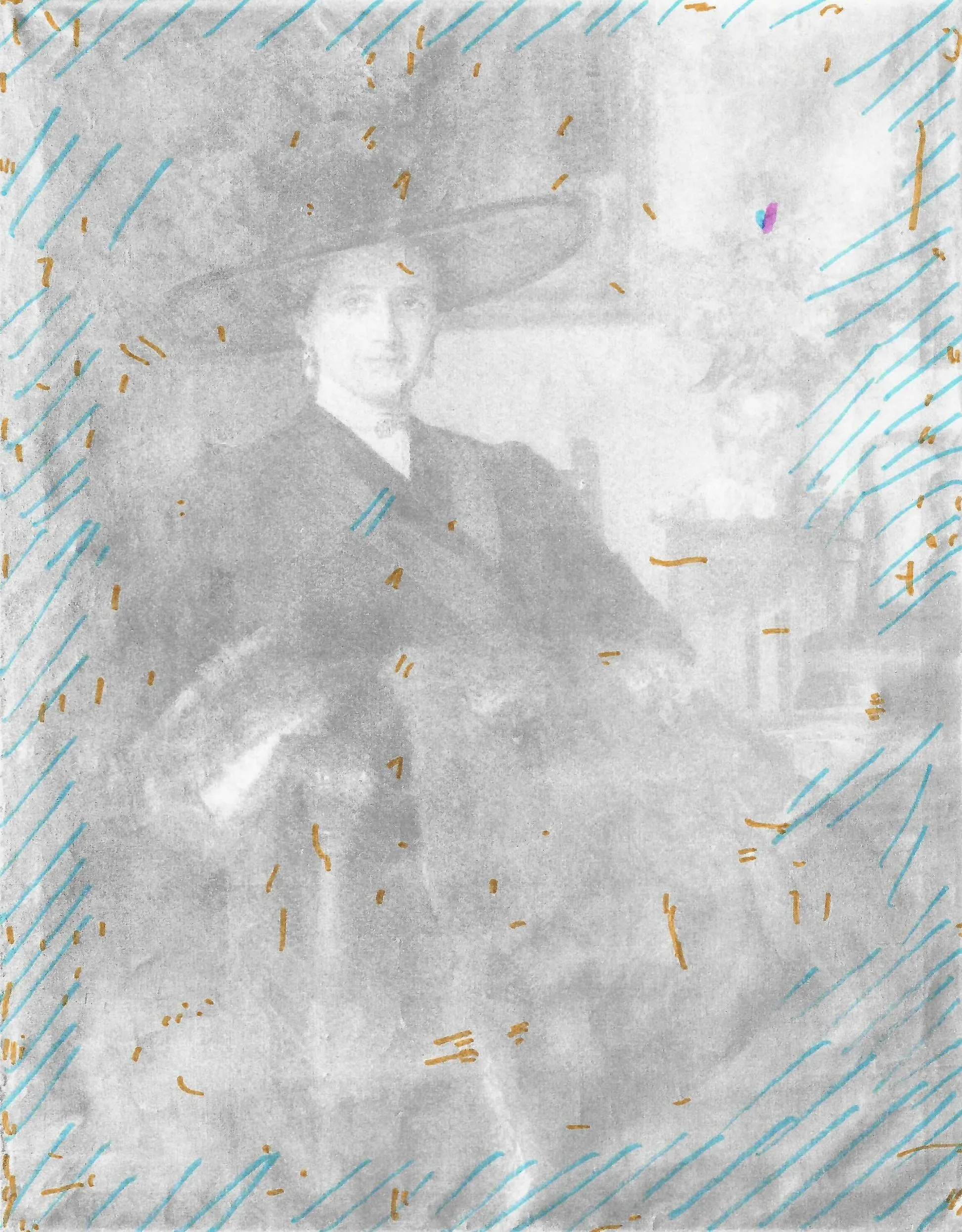
Condition before treatment. Orange indicates areas of paint loss; magenta indicates distortions in the canvas; green indicates tears/punctures in the canvas; blue indicates areas of insecure/lifting paint

Cleaning test
We extend our heartfelt thanks to the generous donors who entrusted these remarkable portraits to our care, and to the dedicated friends and supporters of the museum whose contributions make vital conservation work like this possible. Thanks to their support, we are able to preserve not only the physical beauty of these paintings but also the rich personal and historical narratives they embody. It is a privilege to protect and share these works with future generations, ensuring that the stories of the Olferiev family, and the broader history they represent, remain vividly alive.


