
Russian Peasant Life Through Everyday Objects and Rituals
By the end of the 19th century, about 80% of the Russian Empire’s population were peasants. They lived in villages and towns across the country, following their own traditions, customs, and ways of life. Their daily existence moved with the rhythms of the seasons, the demands of hard labor, and the bonds of close-knit communities.
This month, we highlight objects that capture peasant life, from humble footwear and traditional tools to vibrant pictures and songs. These artifacts reveal both the beauty and the challenges of everyday existence, offering a window into a world that shaped millions of lives across the empire.
Magical Night
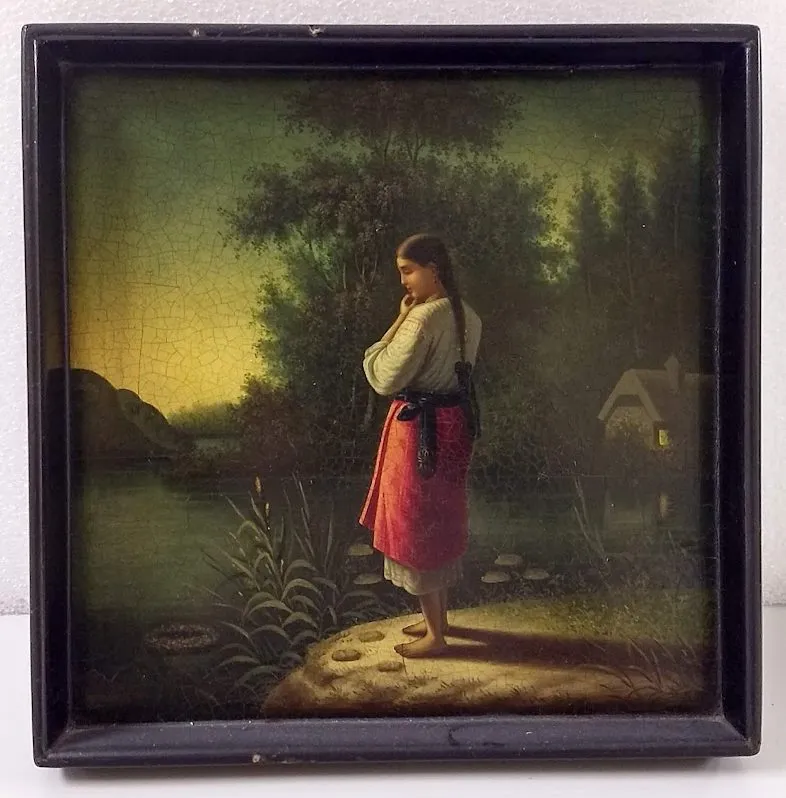
At first glance, this lacquer box might seem to depict nothing more than a young woman standing by the water at sunset. But look a little closer, and something more intriguing appears. In the lower left corner, there’s a wreath floating on the water—a key symbol of the ancient East Slavic holiday Ivan Kupala, celebrated on the night of July 6–7.
Kupala has deep roots in pre-Christian Slavic traditions. Over time, it became a blend of pagan and Christian customs. Long before Christianity reached the region, the Eastern Slavs celebrated the summer solstice, the longest day and shortest night of the year. After the Christianization of Rus’ in the 10th century, the holiday merged with the Feast of St. John the Baptist, giving rise to the name Ivan (the Slavic form of John) Kupala.
The main festivities took place on the night before the holiday and centered around nature, especially fire and water. Young people would jump over bonfires and swim in rivers, believing these acts had cleansing and protective powers.
Herbs and plants also played an important role. One of the best-known traditions was the search for the mythical fern flower, said to bloom only on this night. Whoever found it was destined for happiness, though legends warned that one might encounter dark spirits during the search.
So what is the girl on the box actually doing? It seems she’s taking part in a traditional fortune-telling ritual. On the eve of the holiday, girls would weave wreaths from wildflowers and grasses, wear them during the celebration, and then set them afloat on the water. If the wreath drifted away, it was a sign of luck in love; if it sank, it foretold trouble. Interpretations varied from place to place, but the ritual was always tied to hopes and dreams for the future.
The holiday was also famously portrayed by Nikolai Gogol in his story The Night Before Ivan Kupala, part of his classic collection Evenings on a Farm Near Dikanka.
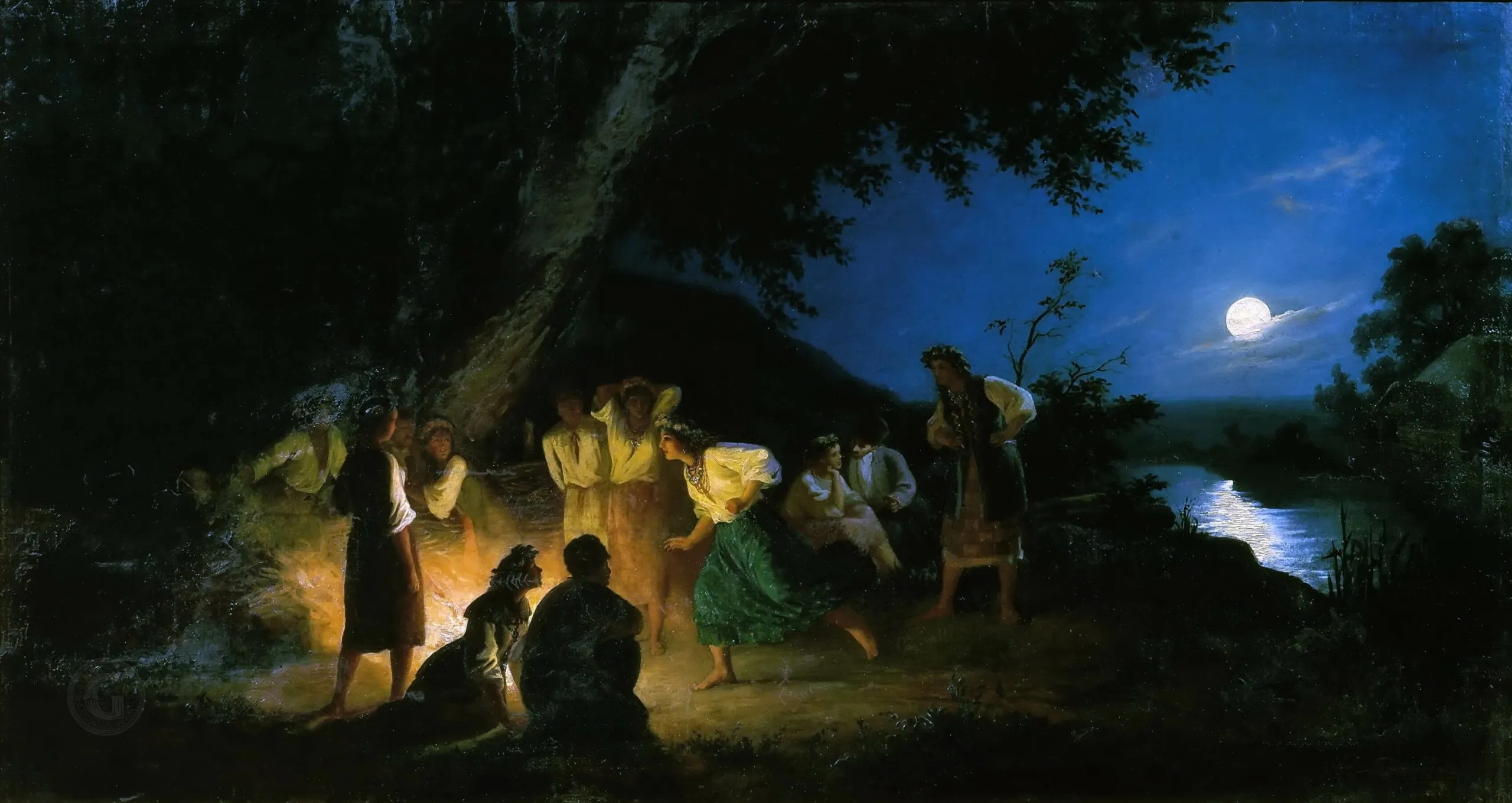
Henryk Siemiradzki. Night on the eve of Ivan Kupala, 1880s. Source: Wikipedia.org
Footwear from Bark
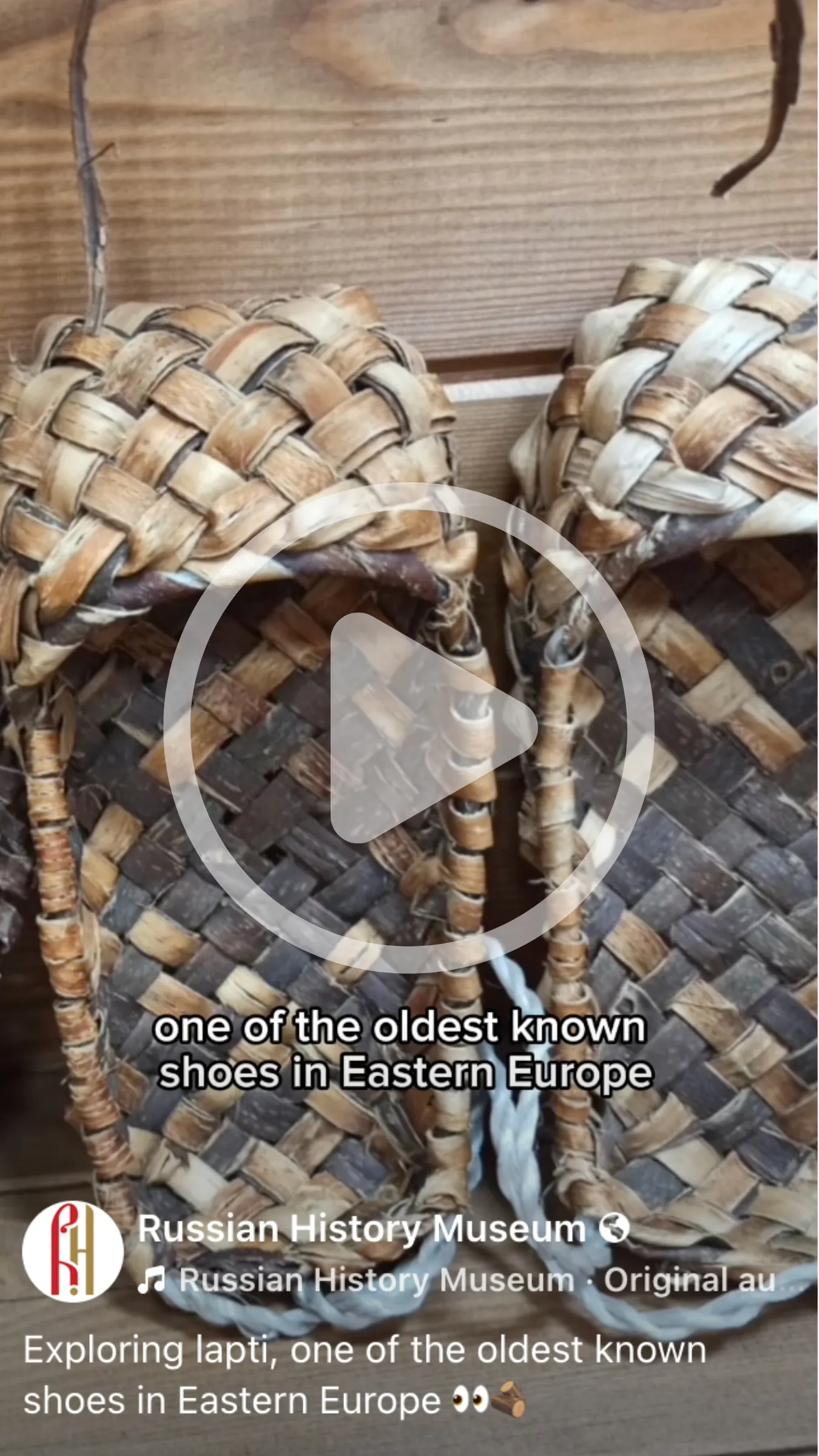
Across northern and eastern Europe, woven peasant shoes were a familiar sight for centuries. In Russia, they are called lapti, a lasting emblem of traditional rural life. Our collection preserves an authentic pair.
Lapti are among the oldest known types of footwear in Eastern Europe. In Russia, they were worn for centuries, up until the mid-20th century. Since most peasants could not afford leather shoes, they wove lapti from tree bark. The ability to make them was essential: villagers learned the craft from an early age, and its techniques were passed down from generation to generation.
Because lapti wore out quickly, a single pair might last only a few days, meaning that one person could need as many as 50 to 60 pairs each year. They were fastened with long laces wrapped around the leg. To protect their skin from the rough bark, peasants wrapped strips of cloth around their feet and legs before putting the shoes on.
In modern Russian, the word lapti sometimes carries a negative connotation, symbolizing poverty or a lack of sophistication. A simple or unrefined person might even be called a lapot’ (the singular form of the word).
Lapti also live on in folklore. A bast shoe, a lapot’, appears as a main character in the popular folk tale The Bubble, the Straw, and the Bast Shoe, which was later adapted into a beloved children’s cartoon.

Scene from the 1959 Soviet animated film "Three Woodcutters," featuring the character Lapot'
Want to see more? Check out our short video featuring the pair of lapti from the museum’s collection.
Traditional Women’s Work
“Three fair maidens, late one night,
Sat and spun by candlelight.”
So begins Alexander Pushkin’s famous Tale of Tsar Saltan. Spinning flax was a common activity for women in Russian villages.
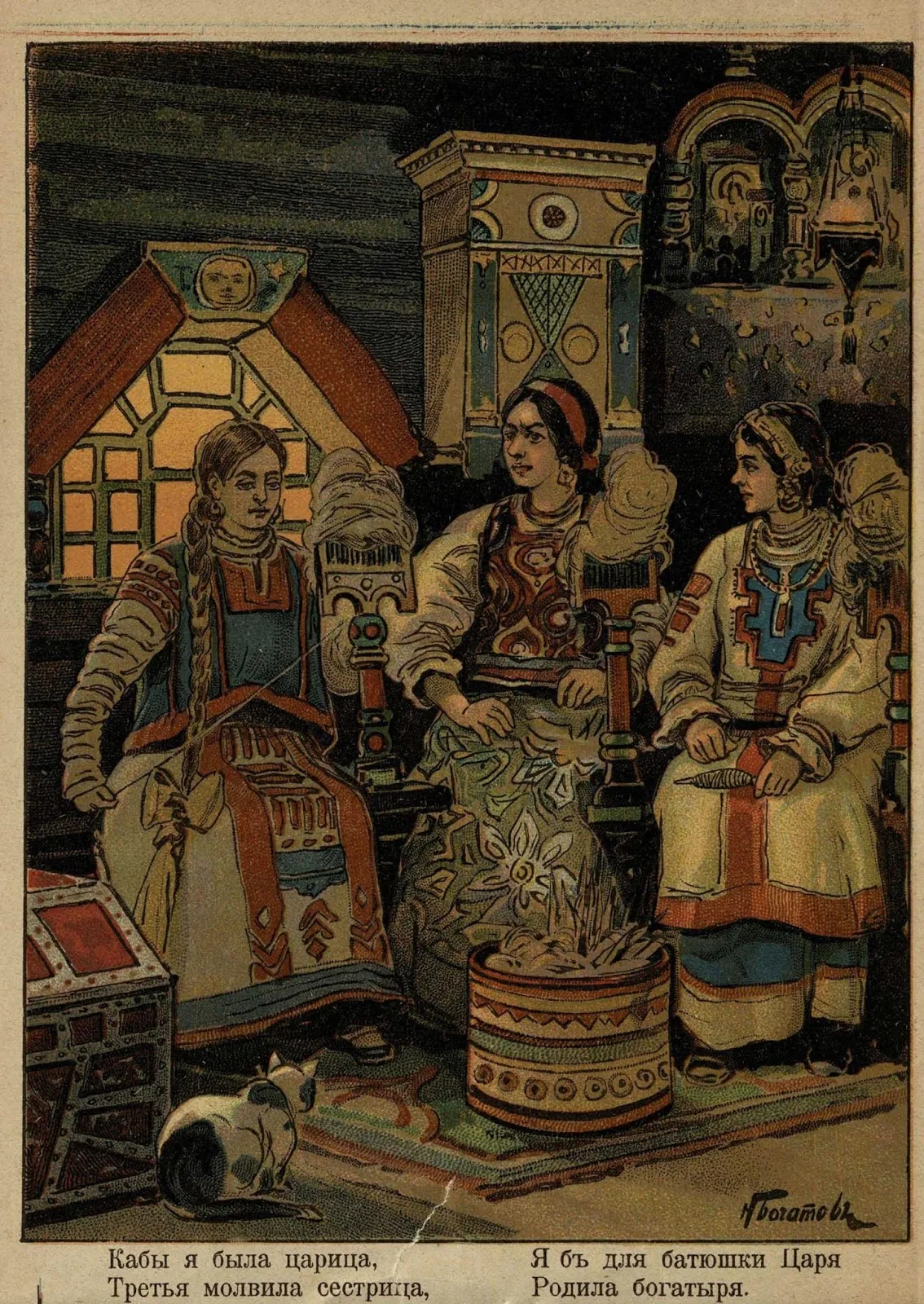
Illustration for the "Tale of Tsar Saltan" depicting three maidens spinning. Artist: N. Bogatov. Source: Literaturus.ru
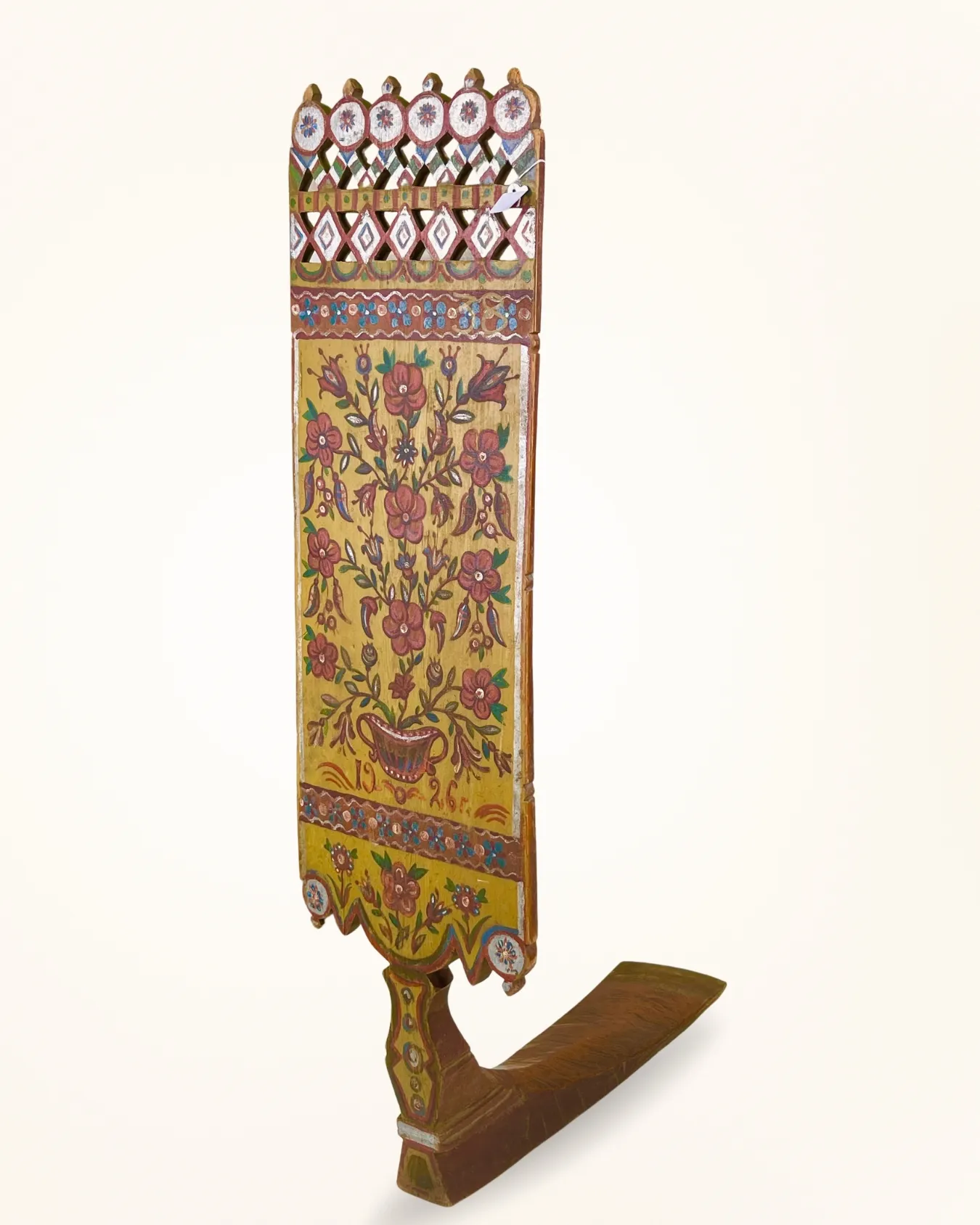
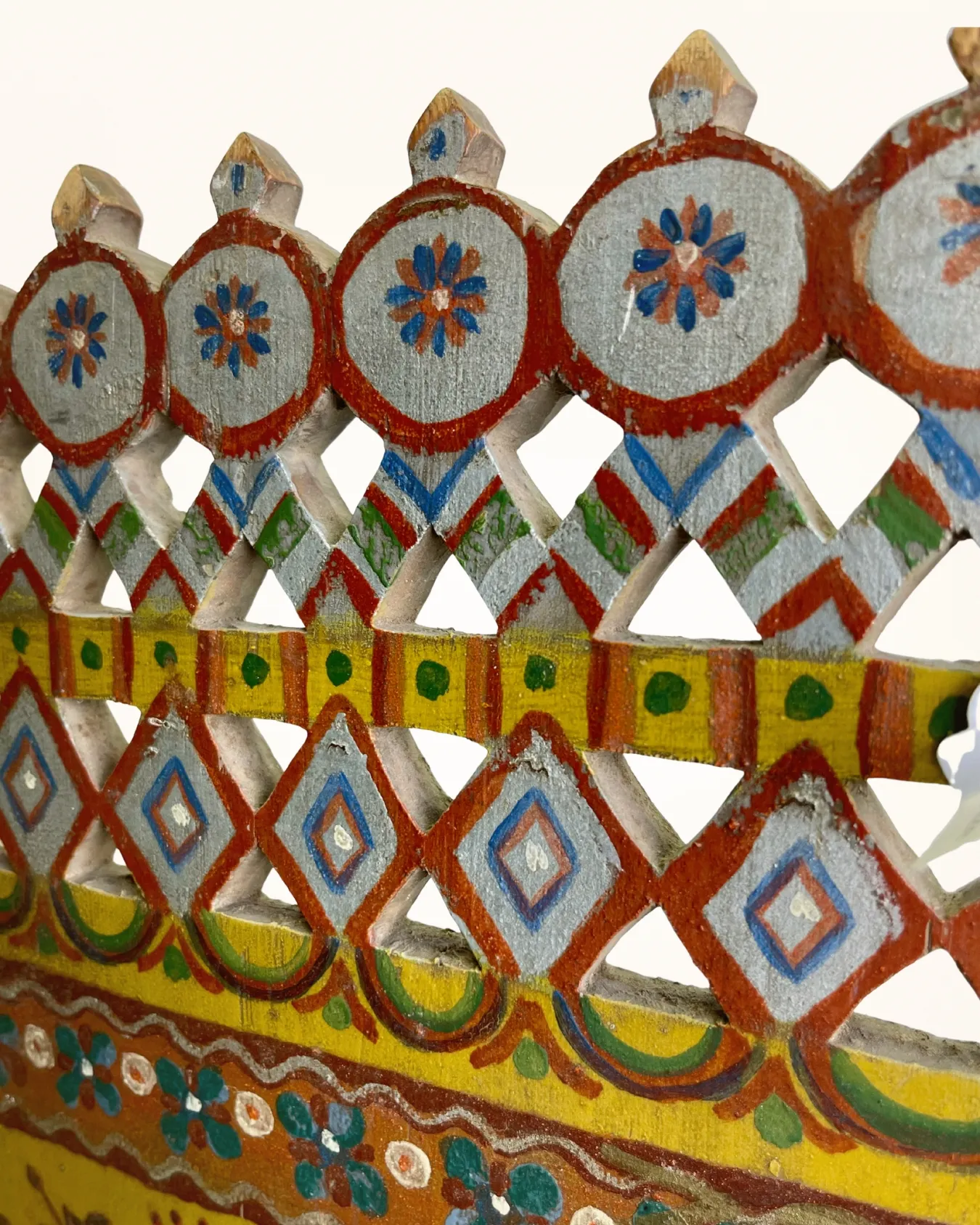
The tool used for holding the unspun flax fibers was called a distaff. Distaffs were commonly decorated with carved or painted designs, oftentimes crafted by the woman’s husband or fiancé. One of the distaffs in our collection, dating to 1926, is decorated with bright colors and floral patterns.
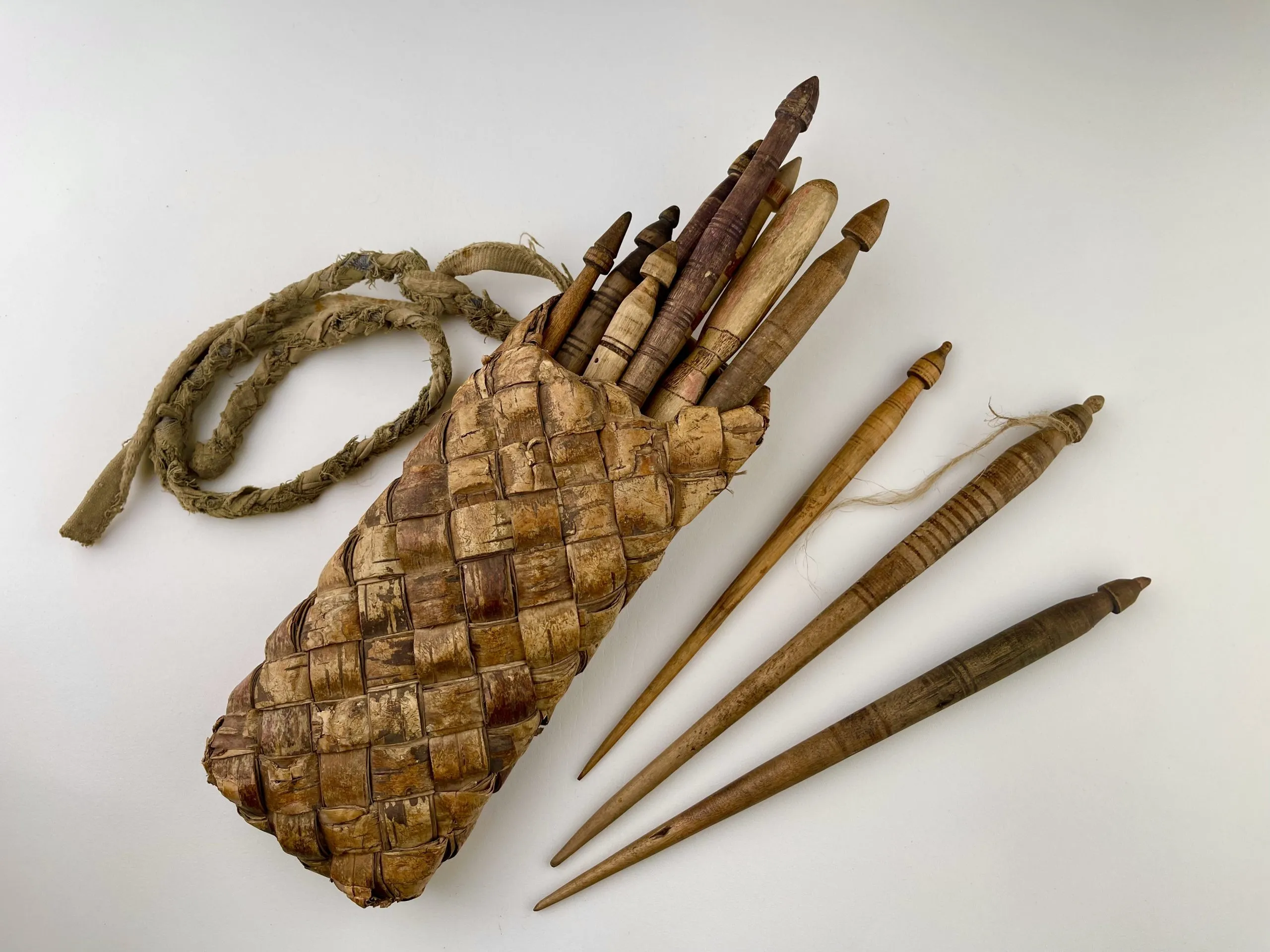
An essential companion to the distaff is the spindle—a slender wooden rod, tapered at one end and slightly thickened at the other, around which the spun thread was wound. The distaff held the fibers in place, while the spindle twisted and formed them into smooth, strong yarn. The museum’s collection also includes a woven pouch used to store spindles of various sizes and shapes, featuring a pattern reminiscent of lapti.
In folk culture, the distaff and spindle symbolized women’s lives and the “thread of fate.” It’s no coincidence that these images appear frequently in fairy tales and songs, from Pushkin’s poetry to traditional folklore across Russia.
When Songs Become Prints
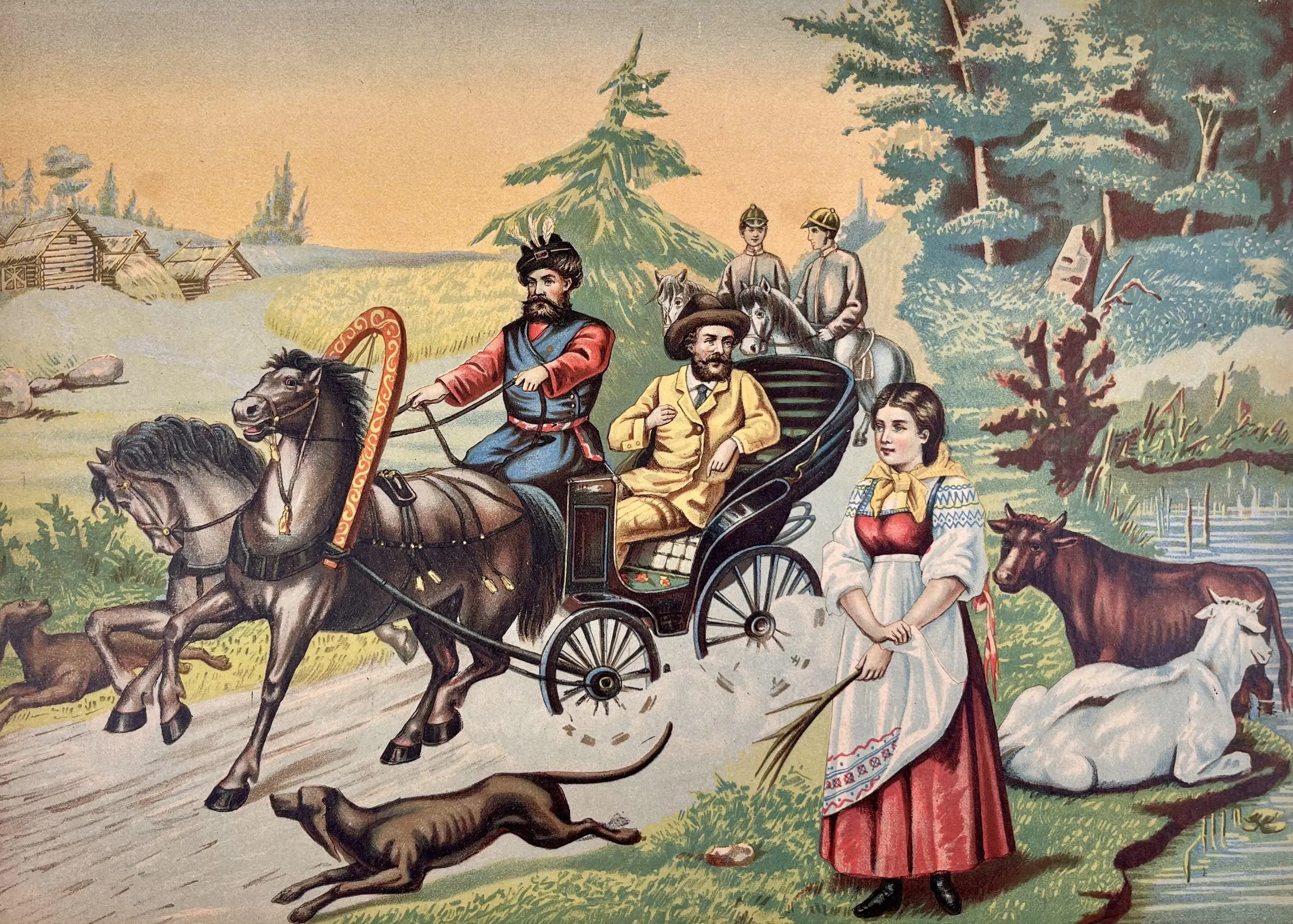
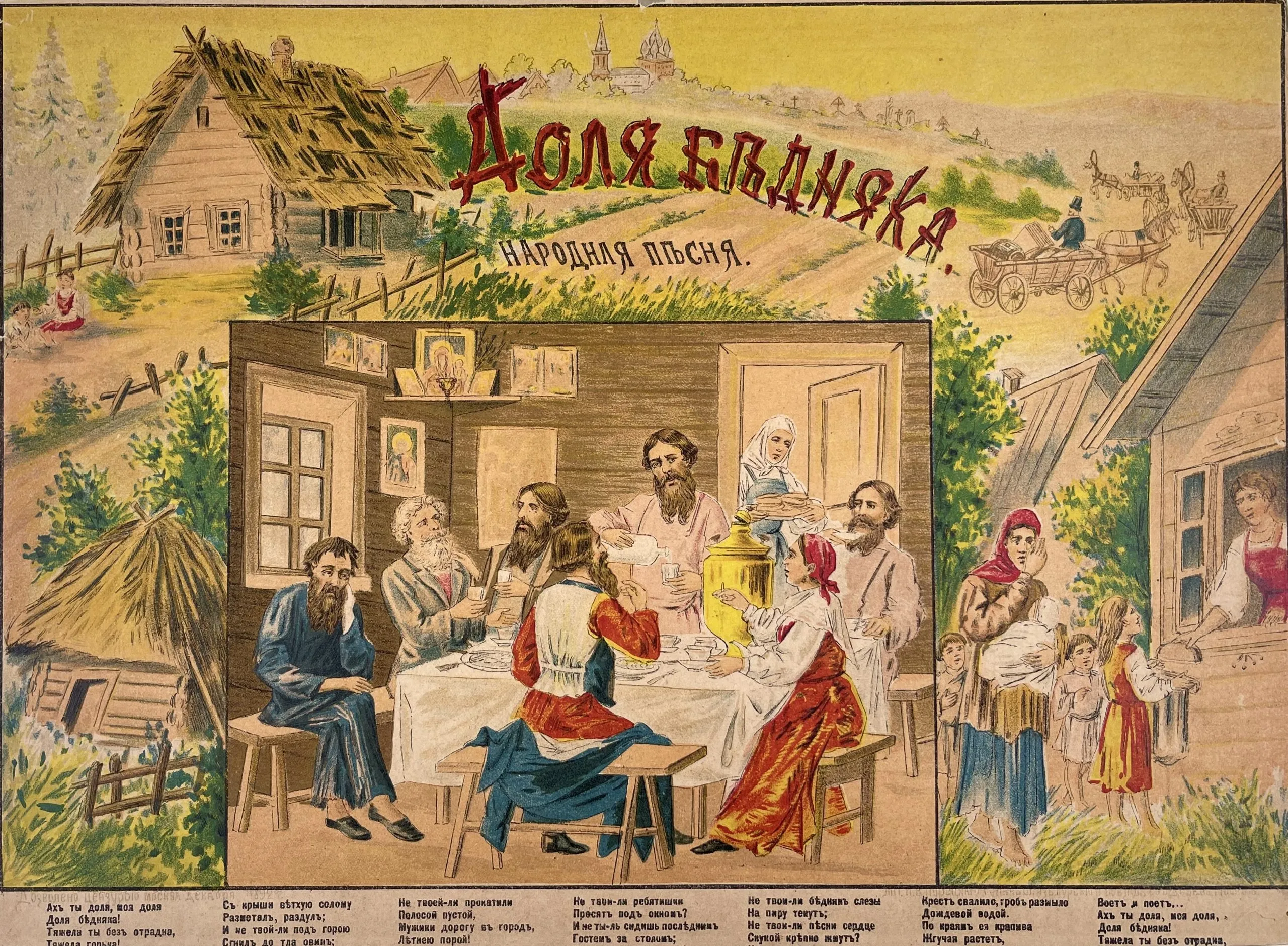
Among the museum’s holdings is a colorful set of lubok-style prints illustrating peasant life. Characterized by vivid imagery and straightforward narratives, lubki were a popular form of visual art accessible to a wide audience, including those with limited literacy.
Traditionally, a lubok was a brightly colored print on paper, accompanied by a brief caption, often written in verse or rhymed prose. The prints in our collection belong to this later tradition. Produced as chromolithographs in 19th-century Moscow, they depict scenes from peasant life, with accompanying song texts printed below the illustrations.
One print shows a feast inside a peasant hut. On the right, a mother arrives with her four children, and the wealthier woman offers them a loaf of bread. Below the image is the text of a folk song called “The Poor Man’s Fate,” explaining the scene:
“Oh fate, oh fate,
The poor man’s fate!
Heavy and joyless,
Bitter and cruel!”
The second lithograph illustrates the song “Late in the Evening from the Forest.” The song is told from the perspective of a young peasant girl driving cows home from the fields at dusk. Along the way, she meets a nobleman returning from a hunt accompanied by dogs. He tells her she was born to be a lady, not a peasant. The song ends with the nobleman marrying her—a kind of “happy ending” and the dream of many peasant girls. In reality, such marriages were extremely rare.
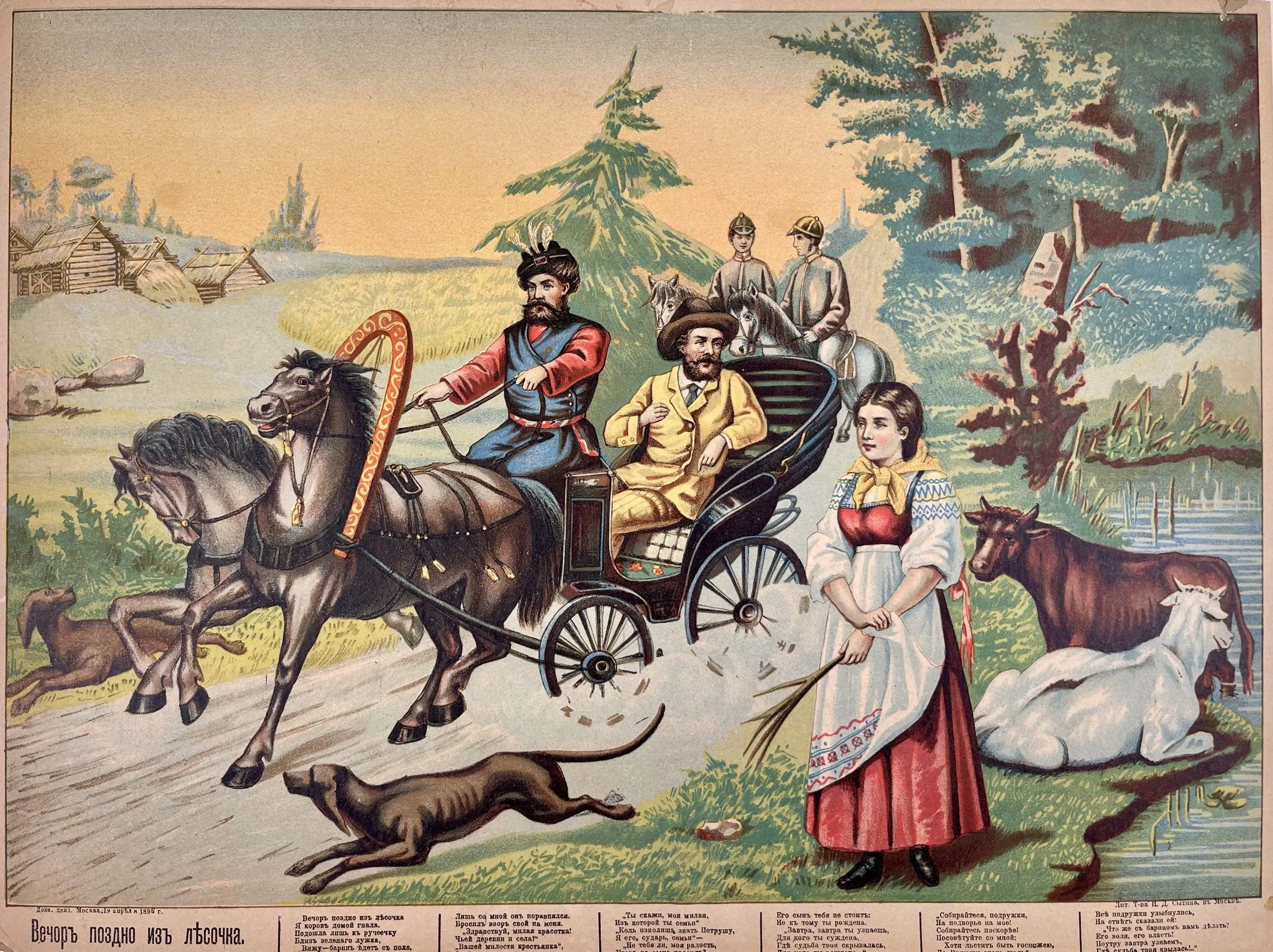
Folk songs like these often inspired lubok sprints—and this is how oral tradition turned into visual form. In the second half of the 19th century, alongside songs, lubok prints also featured poems by A. Pushkin and N. Nekrasov, bringing high literature closer to the common people.


