
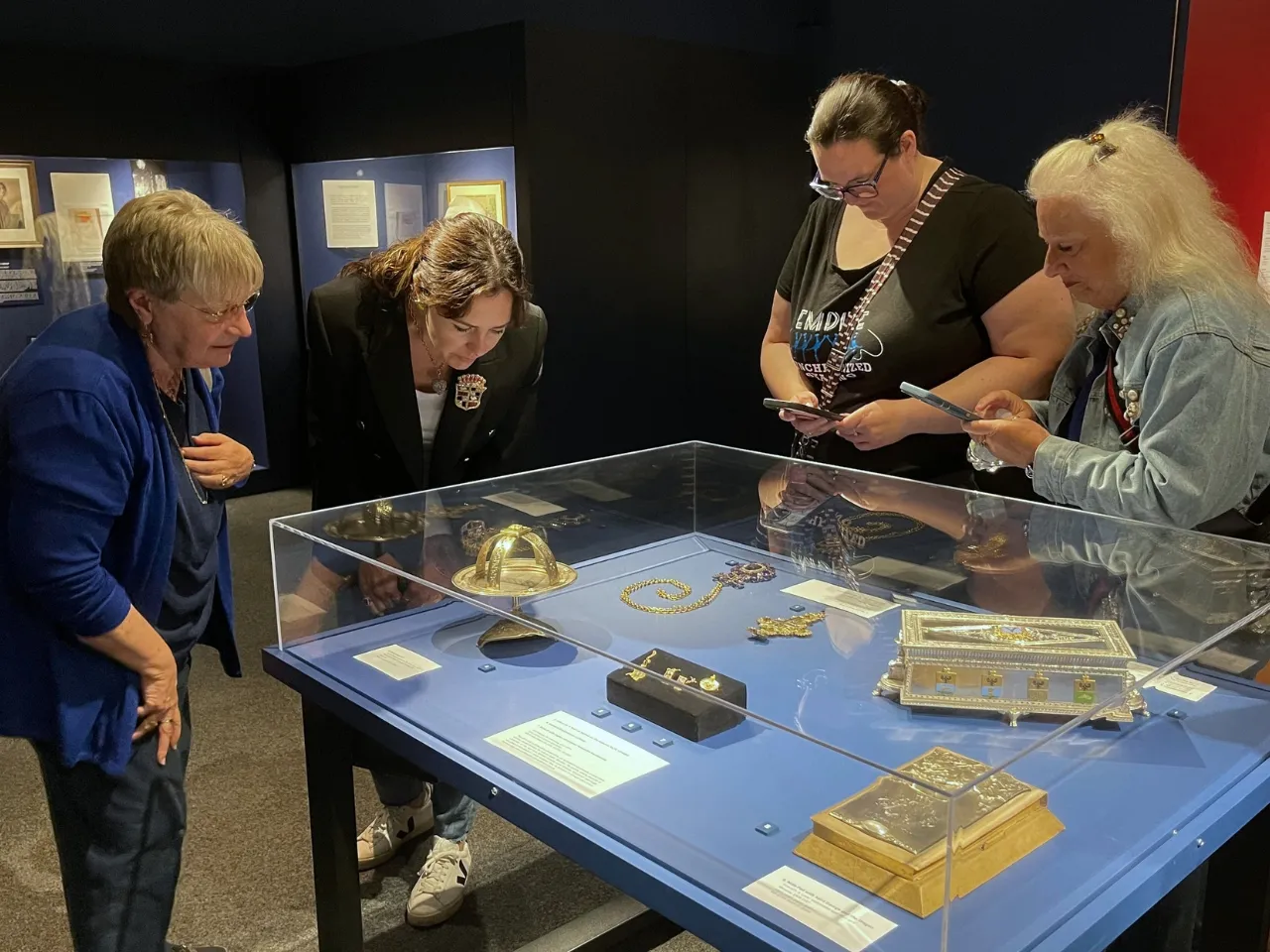
Our Staff Picks: Highlights from the Mysteries and Odysseys Exhibit
Our current exhibition, Mysteries and Odysseys, brings to light some of the remarkable stories behind the artifacts, their owners, and their journeys. Some mysteries have been solved; others remain open. In this spirit of discovery and reflection, we invited our staff to choose a piece from the exhibition they find especially notable and thought-provoking. Each staff member spoke about their chosen object, and we’ve preserved their stories just as they were told—in their own words.
Michael Perekrestov, Executive Director

❝Imagine opening a large envelope and pulling out a folded sheet of paper that looks centuries old. You carefully unfold it, revealing a handwritten document in the formal script of the late 18th century. But what instantly catches your eye is the deep red wax seal and the signature beneath it: ‘Count Alexander Suvorov-Rymniksky.’
You’re holding a letter signed by one of Russia’s greatest military commanders!❞
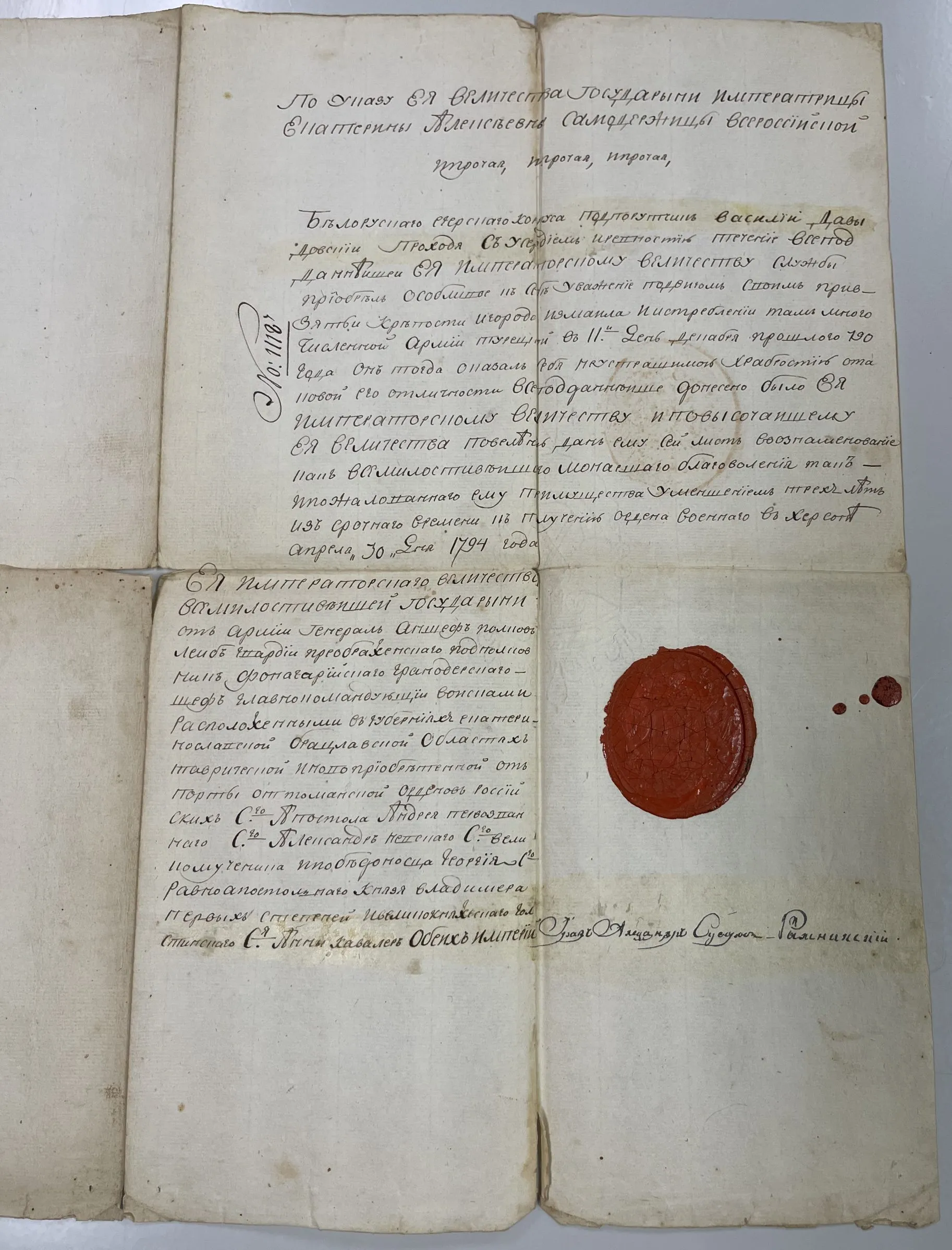
Letter of Commendation for military feats. Issued to Vasilii Davydovskii, signed by Count Alexander Suvorov-Rymnikskii, April 30, 1791. Ink and wax seal on paper
❝This 1791 letter of commendation, praising Second Lieutenant Vasilii Davydovskii for his ‘fearless courage’ during the storming and capture of the seemingly impregnable Turkish fortress of Izmail, is one of the artifacts I find most compelling in our Mysteries and Odysseys exhibition.
As a boy, I was captivated by stories of Suvorov’s daring exploits. Sickly in his youth, he defied expectations and joined the army at 15, rising to become Generalissimo of Russia’s Ground and Naval Forces. Just five feet tall, Suvorov became a legend—not only for his strategic brilliance but for his deep bond with his troops. Among his many astonishing feats, none is more celebrated than his heroic 1799 march over the Swiss Alps, leading a Russo-Austrian force during the Italian Campaign of the French Revolutionary Wars.❞
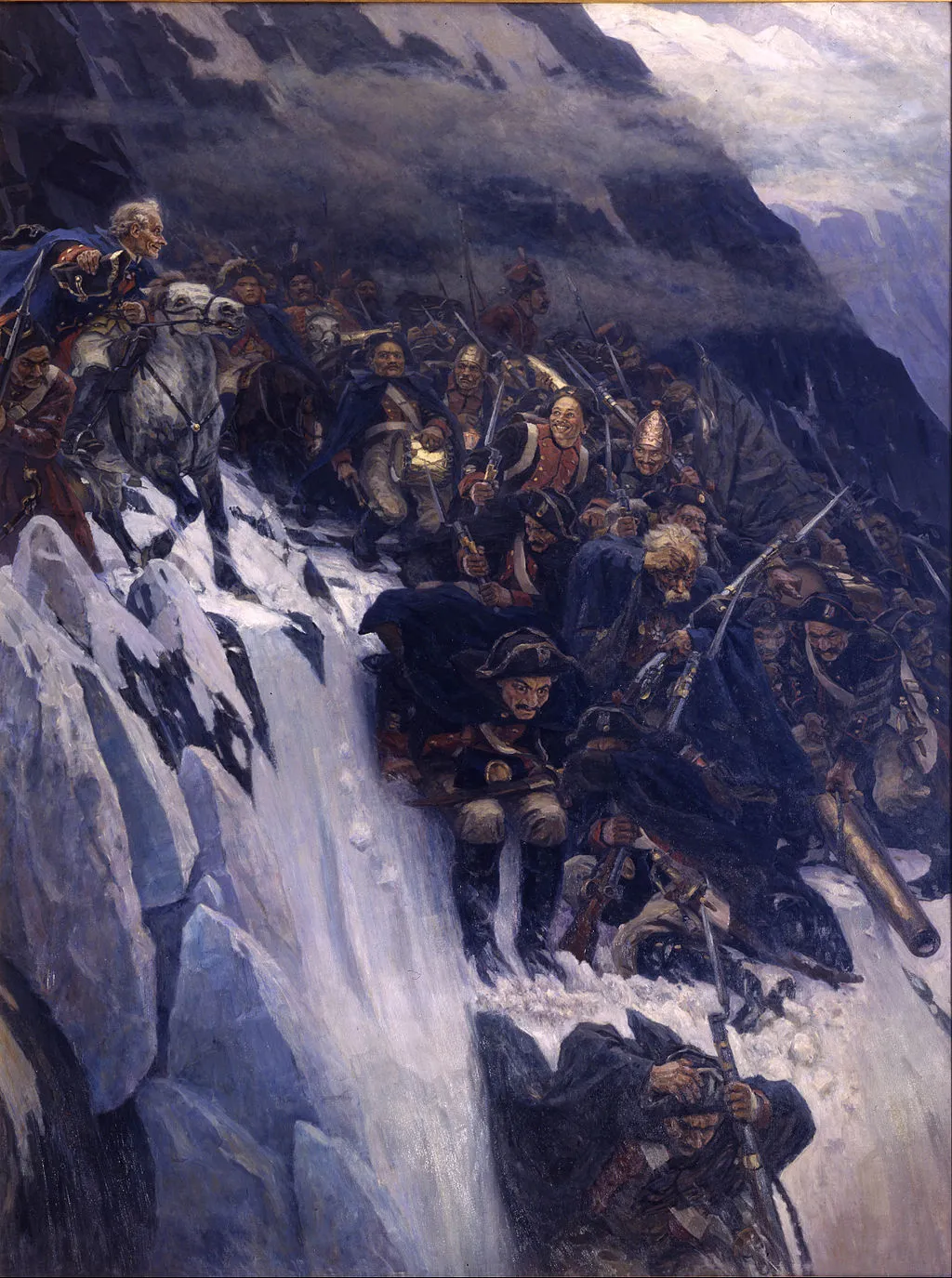
Vasily Surikov. "Suvorov Crossing the Alps in 1799." Oil on canvas, 1899. Russian Museum, St. Petersburg
❝What makes this artifact even more special to me are the circumstances of its ‘discovery.’ As executive director, I’m often invited to review materials that generous individuals consider donating to our museum. You never quite know what you’ll find. In 2023, I was kindly welcomed by Alla Ryl, who invited me to look through a collection of family documents from her late husband, Michael. As I examined the papers, I was stunned to come across this letter bearing Suvorov’s own signature.
It’s moments like these—when history quite literally unfolds in your hands—that make this work so extraordinary.
We are deeply grateful to our remarkable donors who entrust the Russian History Museum with incredible materials like this. Their generosity makes it possible for these treasures to be preserved, studied, and most importantly, shared with you.❞
Andrey Lyubimov, Library Manager
❝As you delve into the history behind our exhibition’s artifacts, you inevitably begin to trace their long journeys from Russia to Jordanville, where our museum is located. One such remarkable journey was taken by the icon of St. Nicholas the Wonderworker, which was once housed in Tauride Palace in St. Petersburg, where the State Duma convened from 1906 to 1917. Initially, the icon was placed in the massive Catherine Hall, where prayer services, molebens, were served on occasion. After the October Revolution of 1917, the icon was relocated to the palace’s Exaltation of the Cross Church, and following the church’s closure in 1920, was transferred to the Museum of Old Petersburg, which was soon dissolved.
What followed remains a mystery.❞
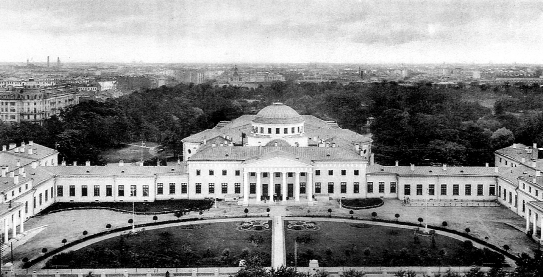
Tauride Palace and Gardens in the early 20th century. Source: Wikipedia
❝To this day, no records have been found to explain how the icon made its way to the United States and, specifically, to Jordanville. This prompts lingering questions: What became of those who took the icon from St. Petersburg? Who brought the image of St. Nicholas the Wonderworker to Jordanville, and when?
Another question that remains is regarding the icon’s authorship. One clue is provided by a 1919 inventory of items transferred to the Exaltation of the Cross Church from the Catherine Hall, which includes the following entry: ‘Icon of St. Nicholas the Wonderworker by Vasnetsov, in a glass-covered, artistically crafted kiot [icon case].’
Viktor Mikhailovich Vasnetsov (1848–1926), a celebrated Russian painter, left behind a rich artistic legacy. Among his best-known religious works are the frescoes of the St. Vladimir Cathedral in Kiev. Could this icon, now carefully preserved at the Russian History Museum, have been painted by this eminent artist?❞
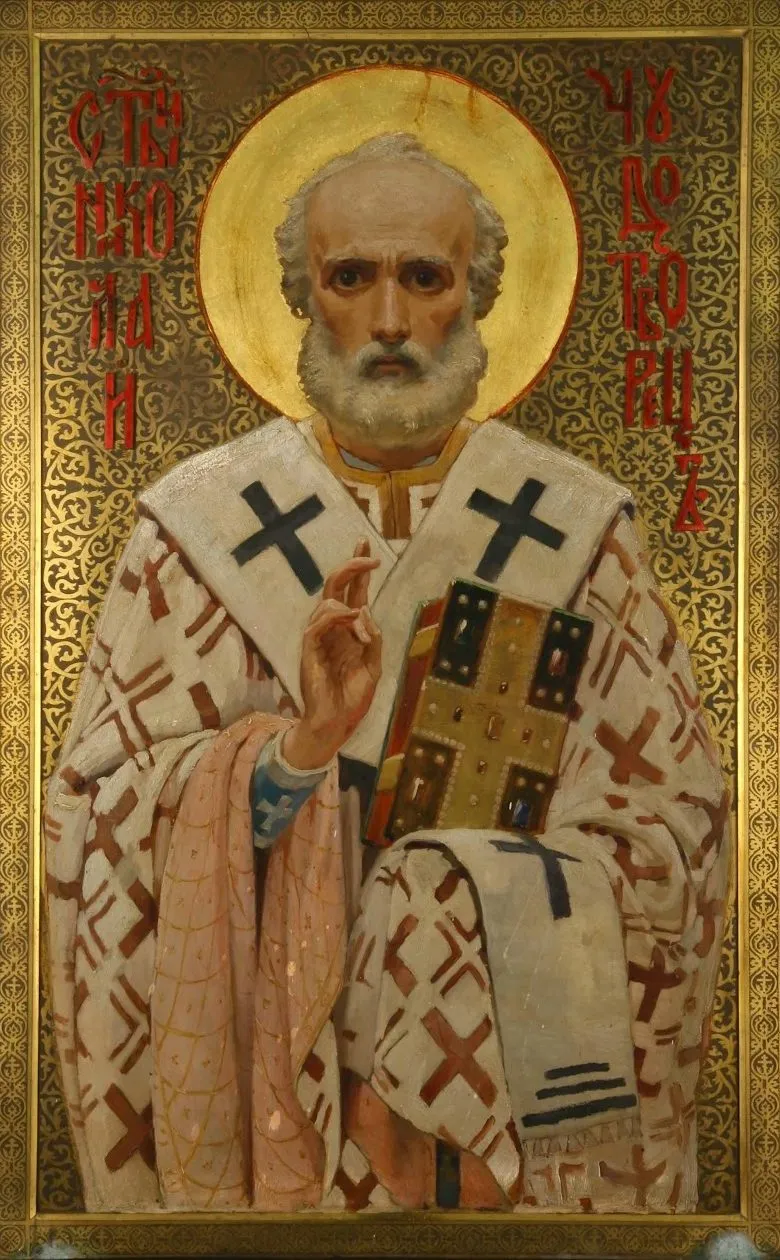
Icon, Saint Nicholas. Oil on metal. Hung in State Duma in St. Petersburg
Carli Mandel, Public Programs Coordinator

❝This brocaded clutch purse always makes me reflect on the different unexpected channels through which history survives. At first glance, the item merely appears to be an elegant evening purse. Upon further reading, one learns that the bag was repurposed using fabric taken from a Russian Orthodox church vestment.
Allegedly from the ‘Imperial Chapels of the Romanovs,’ the fabric was saved from Soviet destruction by American art dealer Armand Hammer—who transformed the vestment into a luxury purse for sale.❞
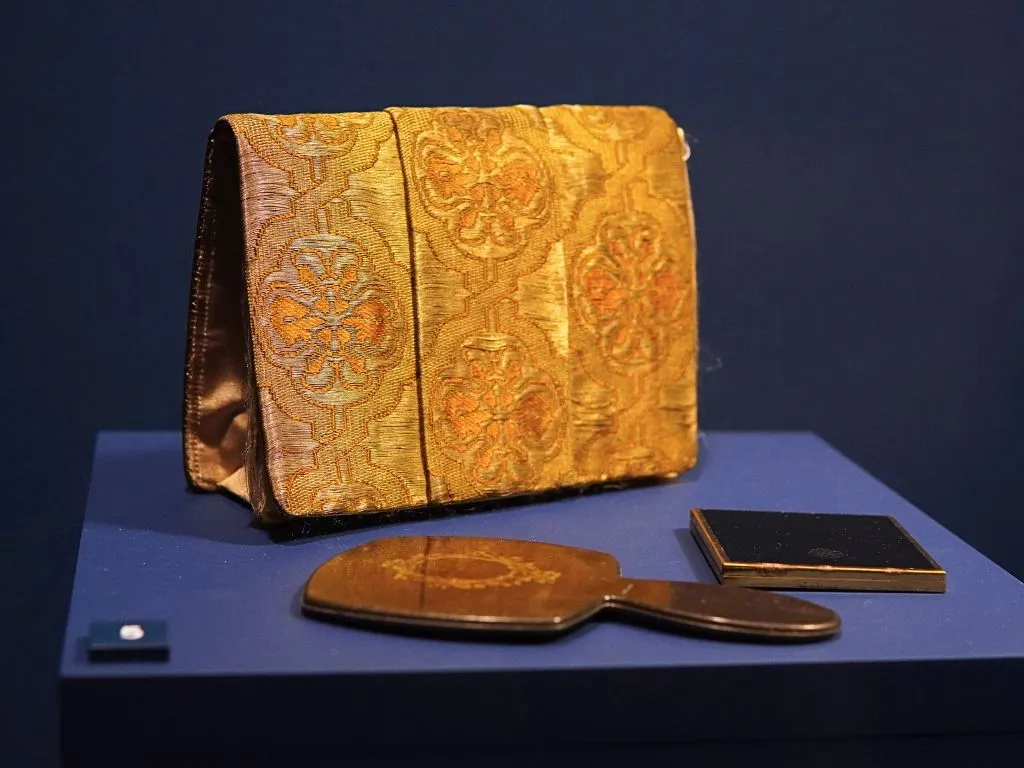
Evening bag woven in Byzantine medallion design, 1937
❝As a historian, I’m troubled by the erasure of history and commodification of sacred objects. Yet I’m also aware that the repurposing of objects is often what allows fragments of the past to endure. History, after all, is the study of fragments of past lives, piecing together knowledge from items that have lost their original context. I’m reminded of Holocaust-era gold bars, forged from personal items like wedding rings and gold teeth—melted down to fund the very war that claimed their owners’ lives.
Stripped of their original meaning, these objects didn’t lose their history; but simply took on a different, haunting form. This purse reminds me that even the most personal items we treasure today might one day be disconnected from us and our lives, surviving only as fragments. What will they say about who we were, what we valued, and our legacy?❞
Anastasia Shteinert, Communications and Engagement Manager

❝What I love most is writing and reading stories, which is why in museum work I have always been drawn not so much to the objects themselves, but to the people and events connected with them. Like everyone else, I enjoy admiring elegant jewelry or skillfully painted artworks. But there is a special charm in seemingly unremarkable items, because often they can tell us much more than visually striking things.
One such object for me is a family scrapbook donated to our museum several years ago. In the Mysteries and Odysseys exhibition, one photograph from that album is featured separately. It depicts a man lying in a hospital bed, surrounded by nurses. This is Alexander Prokofiev de Seversky, a Russian-American aviation pioneer and advocate of strategic air power.❞
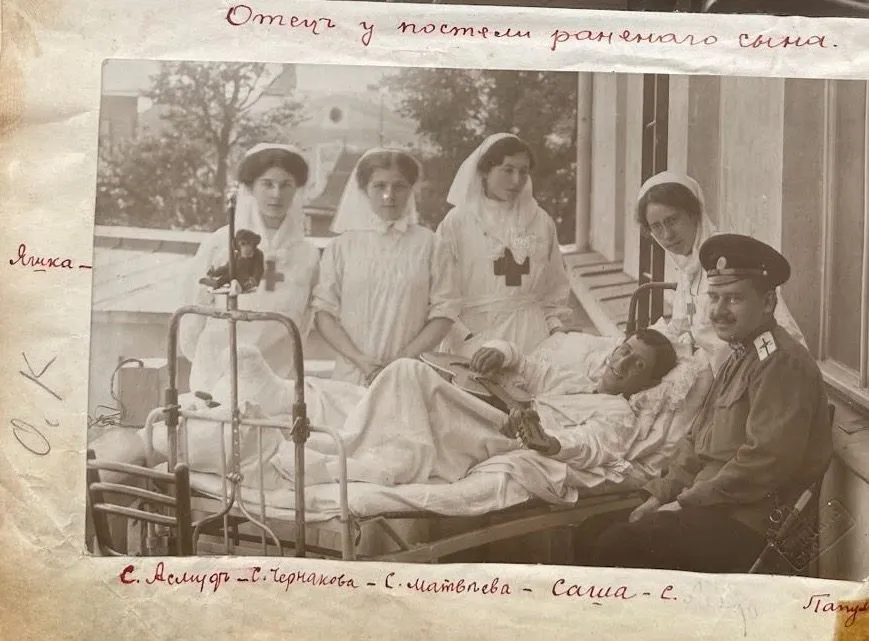
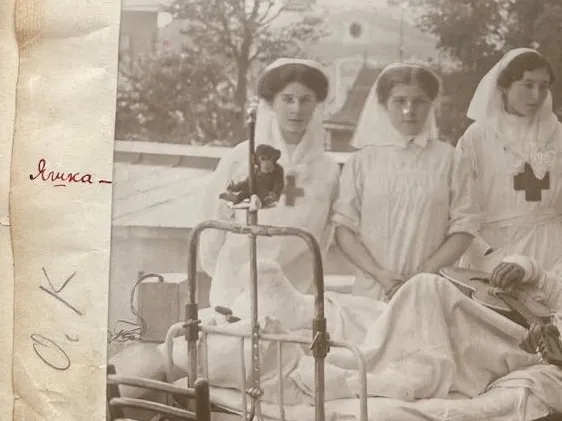
❝What is especially unusual in this photo is a small stuffed monkey resting on the bed’s top rail. Why is it there? Here begins a lovely family anecdote that later became the plot of a famous writer’s short story.
In 1915, a plush monkey named Yashka was given to ‘Sashka’ (Alexander Seversky’s nickname) by his sister during a hospital visit. Yashka comforted Alexander while he was recovering after losing a limb on a WWI combat mission.
The tale of ‘Sashka and Yashka’ was recounted in a story written by the prominent Russian author Aleksandr Kuprin. ‘At night I cannot sleep, everything hurts, but he sits right beside me and comforts me, urging me to endure,’ Alexander Seversky explained his ‘friendship’ with Yashka in Kuprin’s story.
As Alexander resumed his work, Yashka remained his mascot, perched on the nose of his plane. In 1918, Seversky came to America as an assistant naval attaché and never returned to Russia.
Such a warm and rich story lies behind a black-and-white photograph displayed in our exhibition. Don’t skip seemingly unremarkable objects—often, they turn out to be the most fascinating for those curious enough to look closer.❞
John Kurr, Collections Assistant
❝When walking through the museum, I find the “Joy of Wanderers” icon especially striking. Created around 1925, it presents a captivating and unconventional composition: the Mother of God watching over the ships of the White Russian forces as they evacuate from Crimea. The central image is bordered by a wreath of thorns.❞
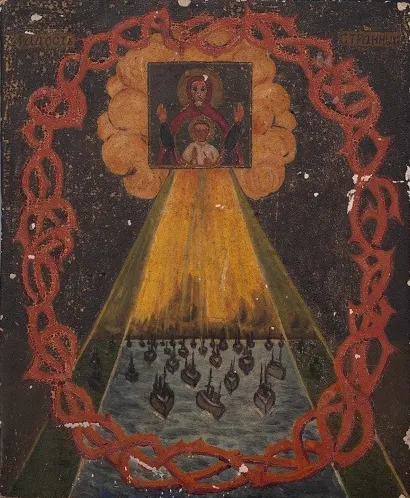
Icon of the Mother of God “Joy of Wanderers,”ca 1925. On reverse is inscription to General Wrangel from Priest Peter dated April 6/19, 1925, Serbia
❝This alone is visually and thematically powerful, but the icon becomes even more compelling when you learn that its inspiration came from a vision experienced by one of the refugees. On the reverse of the icon is an inscription to General Wrangel from Priest Peter, dated April 6/19, 1925, Serbia.
Simply looking at the icon and considering its historical context, one can imagine the emotion it evoked—the anguish felt by the thousands of Russian refugees who were forced to flee their homeland into the Western wilderness.❞
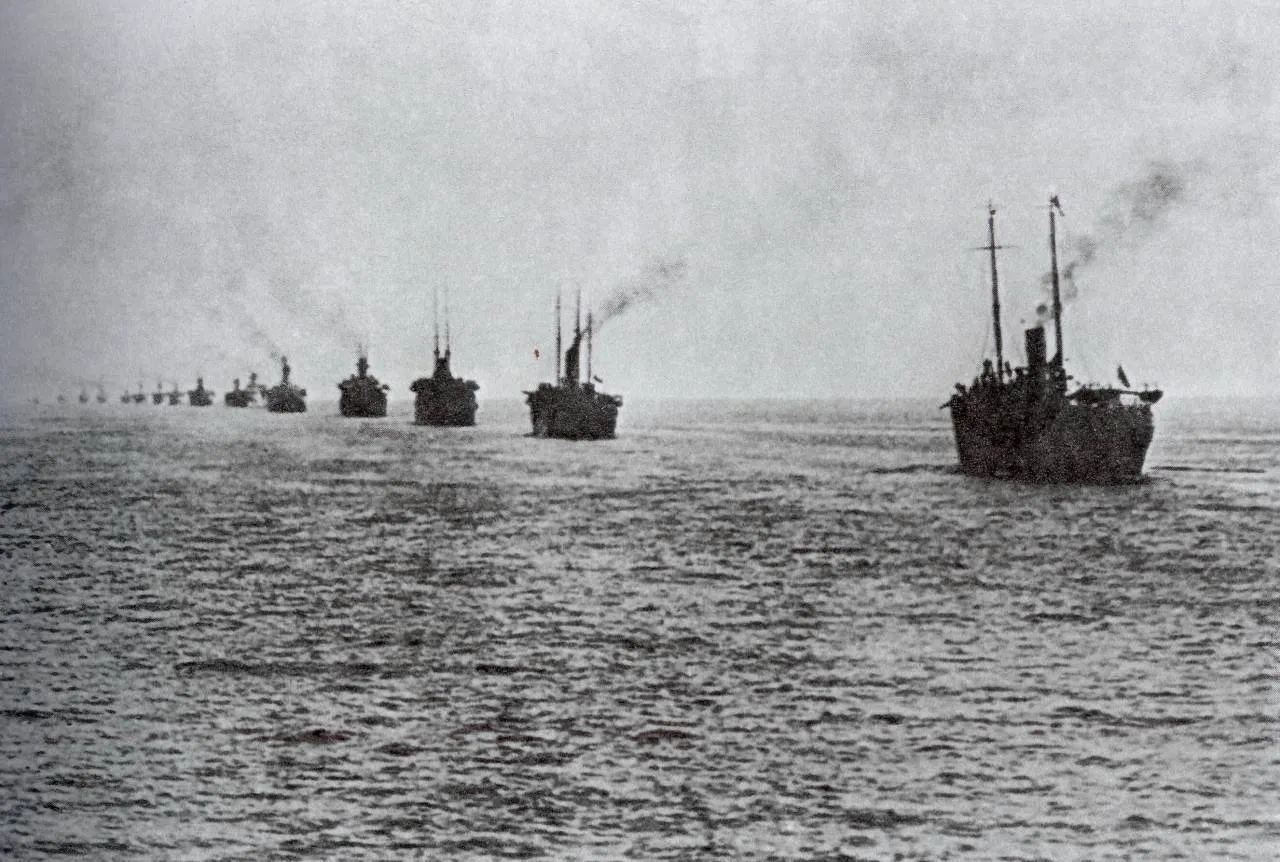
Evacuation of Pyotr Wrangel's Russian Army from Crimea. November 1920. Source: Wikipedia


