
Iconic Treasures: Exquisite Religious Artifacts from the Russian History Museum
Authors: Anastasia Shteinert, Michael Perekrestov
A diptych presented by a Romanov. A sumptuous family heirloom surviving civil war. A jeweled mitre that once crowned the head of a prominent church leader. These are among ten objects on loan from the Russian History Museum to a new exhibition at the Icon Museum and Study Center in Clinton, MA, titled Heavenly Excess: Luxe Icons from Late Imperial Russia.
Lavishly fashioned from gold, silver, enamel, ivory, and gemstones, each piece dazzles with its expert artistry—but beneath the surface lies a rich, often poignant history shaped by the seismic events of the 20th century.
In this article, explore seven exceptional pieces and uncover the craftsmanship, symbolism, and stories they reveal about a bygone era.
1. A Luxurious Wedding Gift

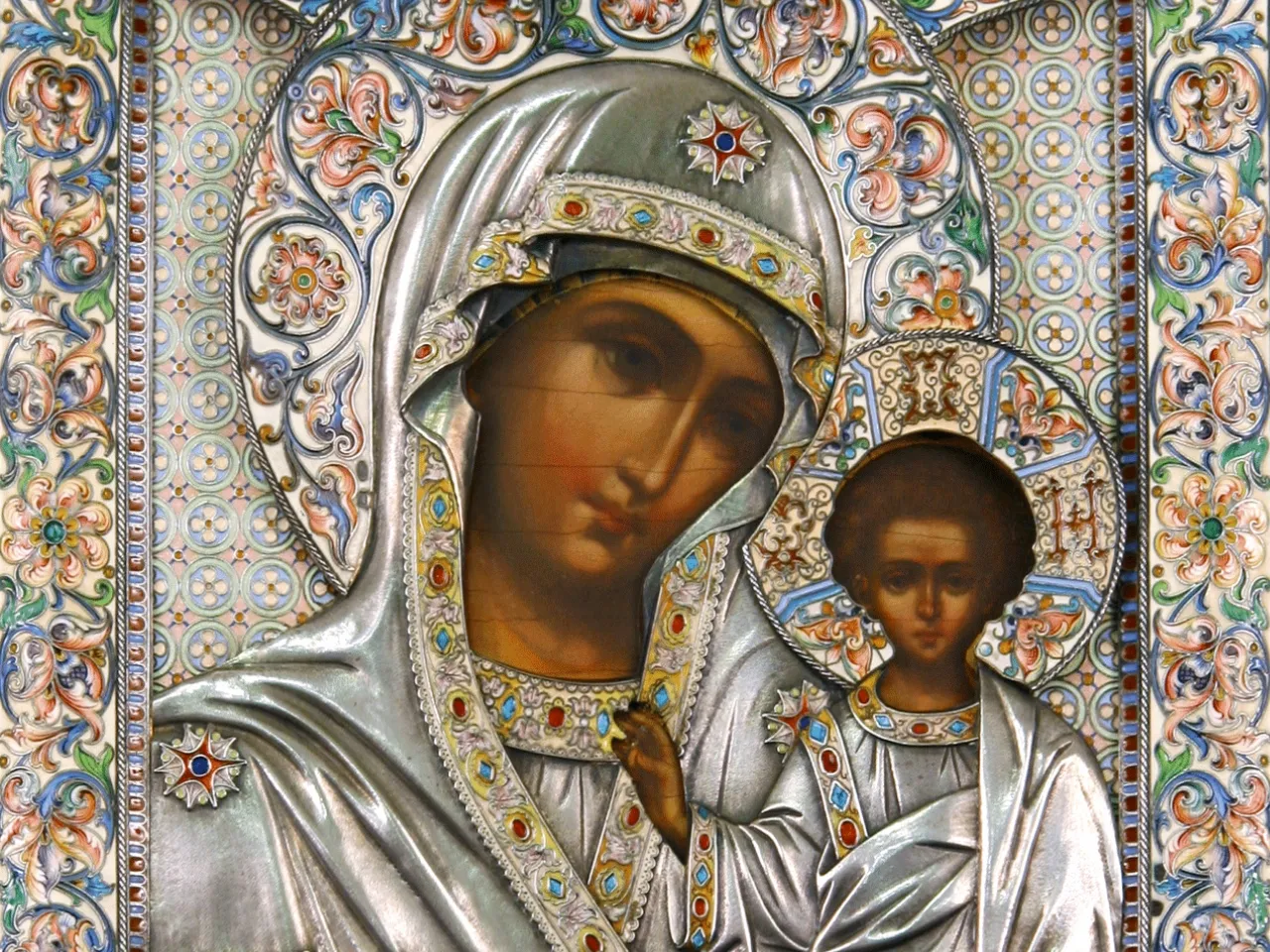
Kazan Mother of God. Feodor Rückert (1840-1917) for the Firm of Ivan Khlebnikov Moscow, 1896-1908
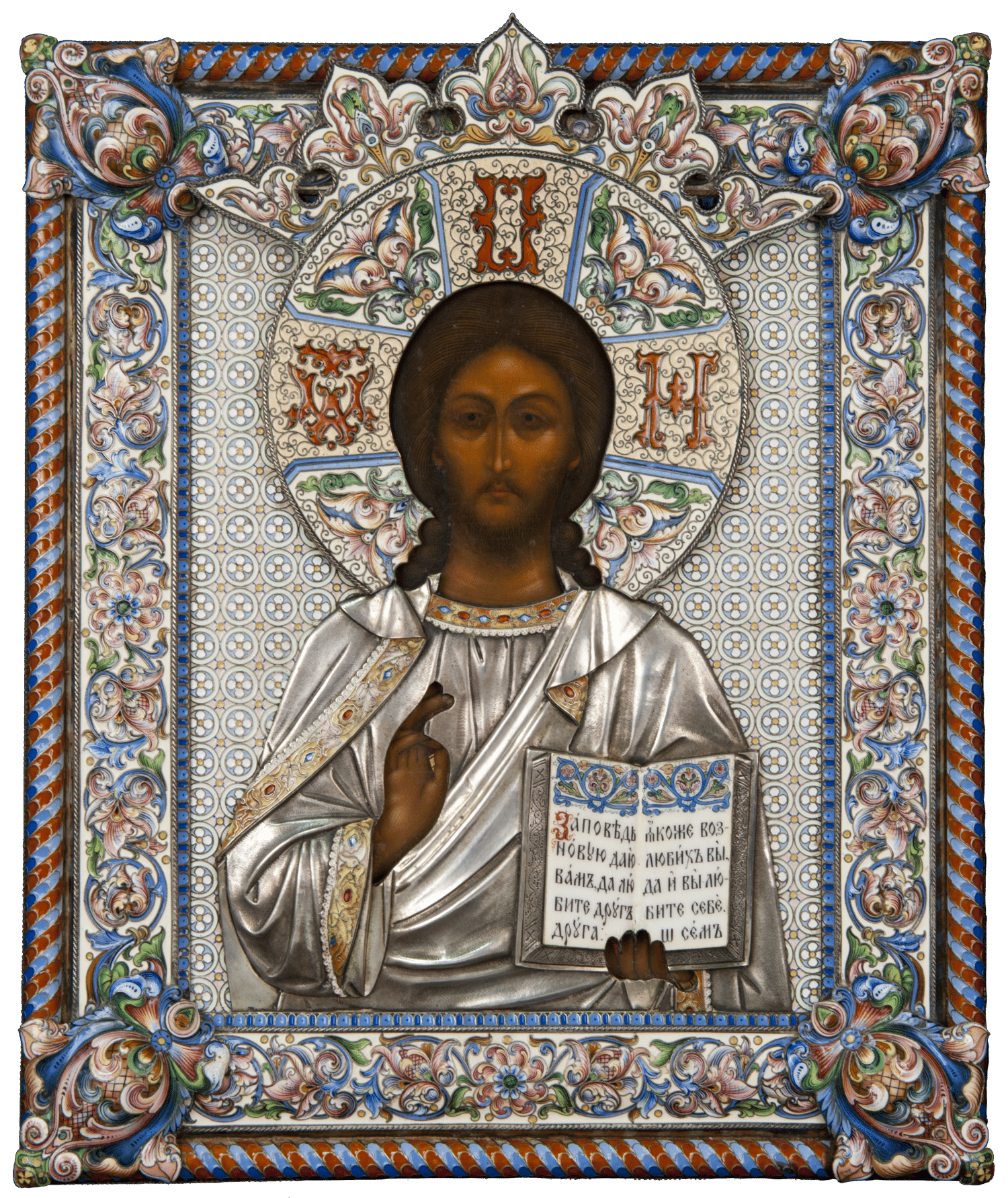
Icon of Christ Pantocrator. Feodor Rückert (1840-1917) for the Firm of Ivan Khlebnikov Moscow, 1896-1908
The exquisite craftsmanship of Feodor Rückert, one of the most accomplished silversmiths and enamellers working in Russia at the turn of the 20th century, is on full display in this pair of icons. Produced for the firm of Ivan Khlebnikov, purveyor to the imperial court, these icons feature ornate covers—called oklads or rizas (literally “robes”)—profusely decorated with shaded cloisonne enamel ornamentation in the “Old Russian” style, a 19th century interpretation of 17th century Russian designs.
The icons feature images of Christ Pantocrator and the Kazan Mother of God. The similarity in size and decoration suggests that they are a pair intended to be used as wedding icons. In the Russian Orthodox tradition, there is a practice of presenting a pair of icons–one of Christ, the other of the Virgin Mary–to the bride and groom as a blessing by their parents. During the wedding service, the icons are placed in the center of the church. Subsequently, the icons are kept by the newlyweds in their home, forming the core of their icon corner, and becoming a treasured heirloom.
2. A “Family” Icon
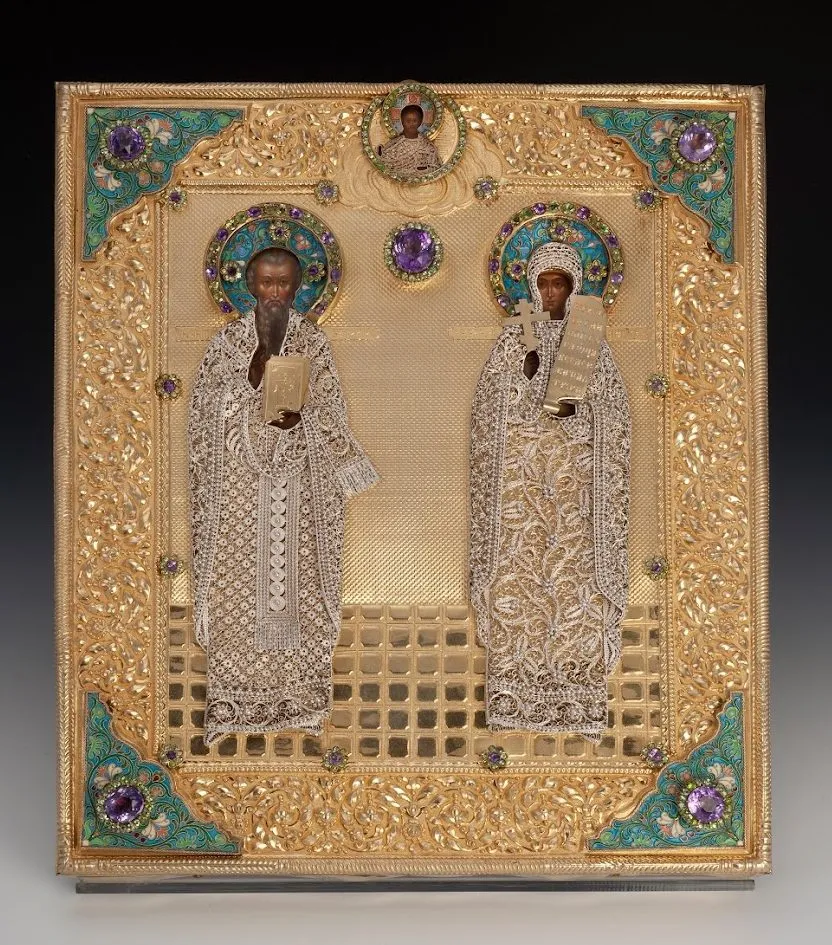
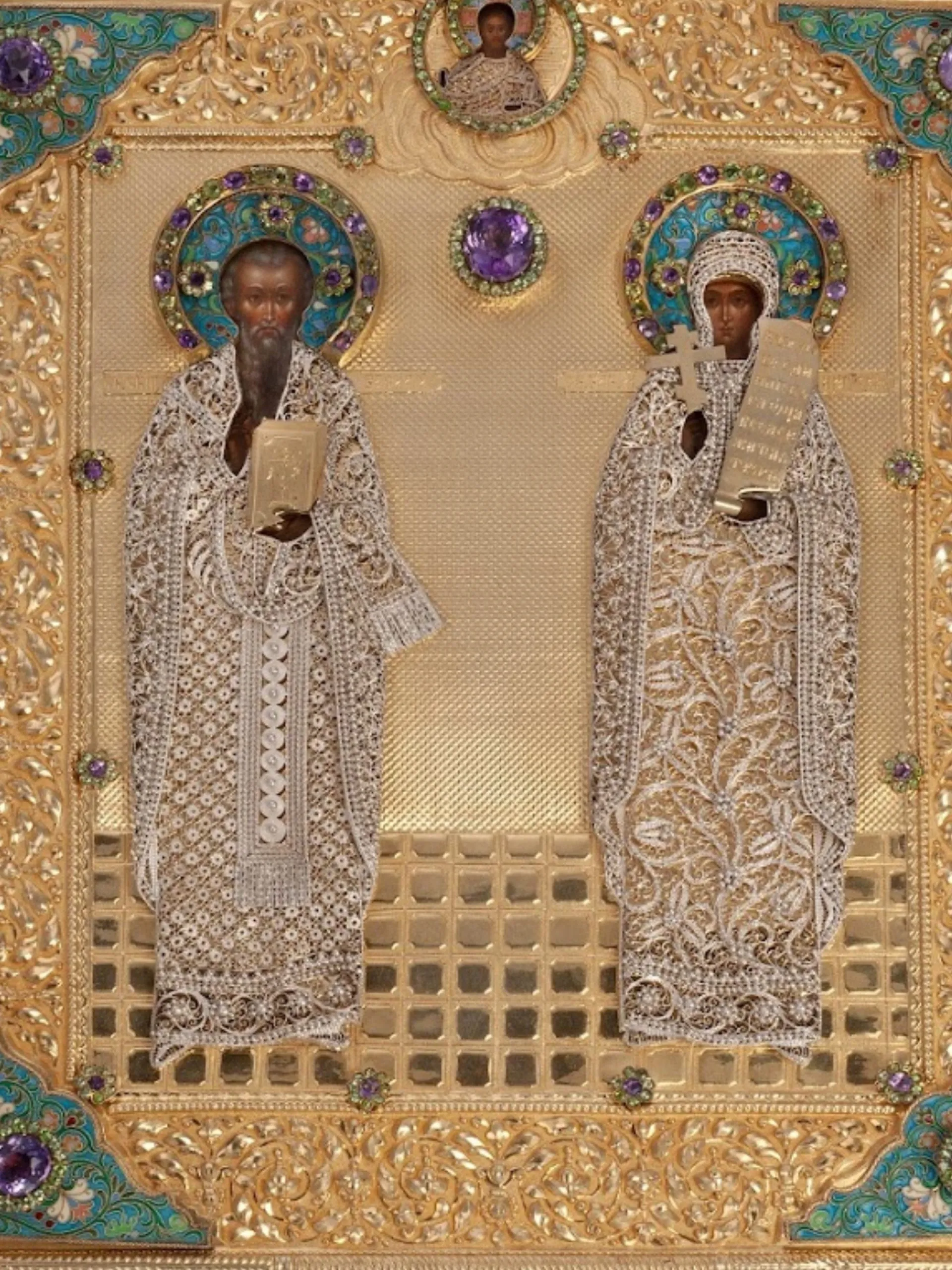
Icon of Saints Basil and Paraskeva. Firm of Iakov Mishukov. Moscow, 1896 - 1908
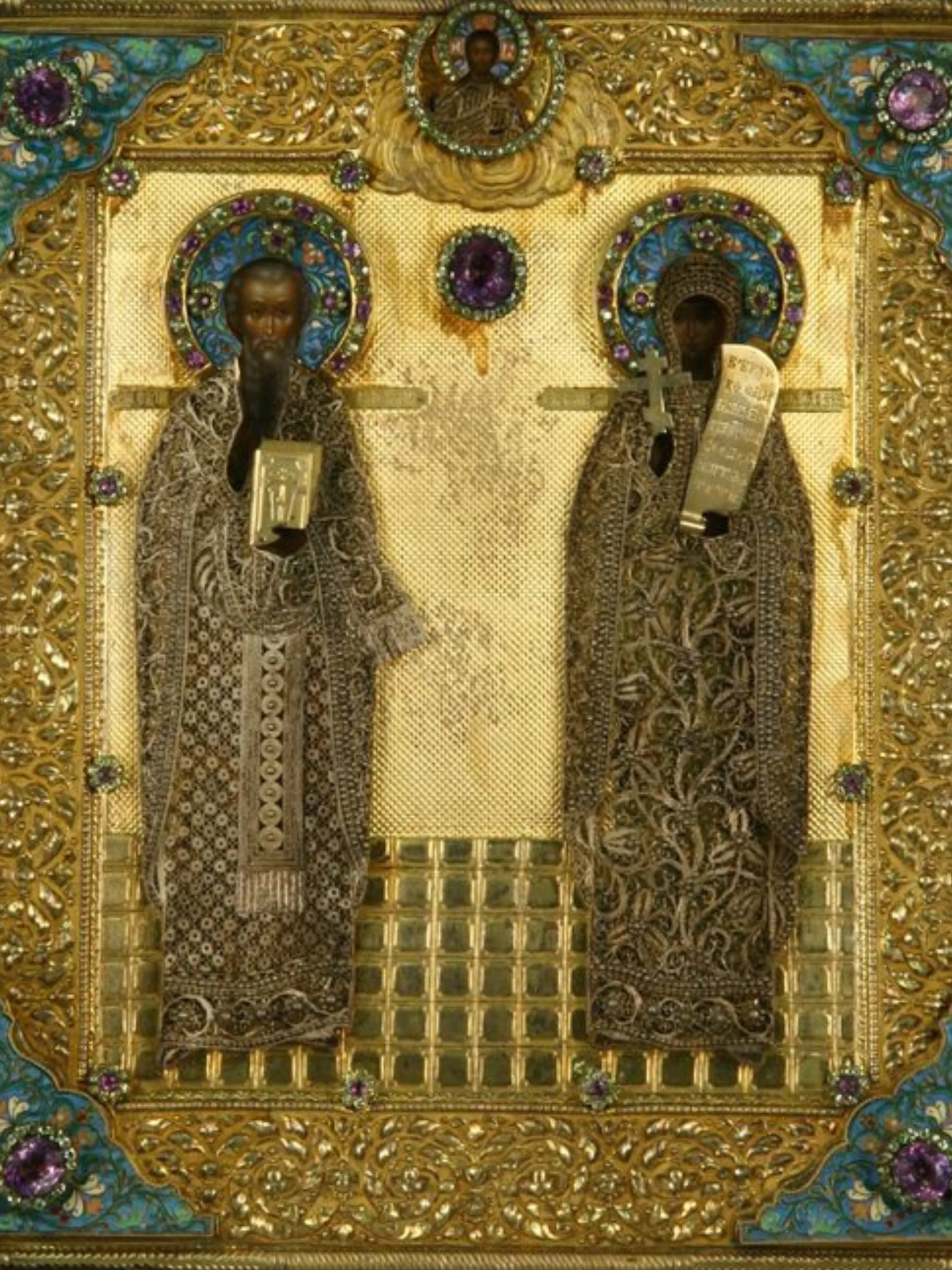
This icon of Sts. Basil and Paraskeva is another example of a religious object that was likely commissioned for or by a married couple. Icons depicting the patron saints of individual members common in the Russian Empire, and it is reasonable to assume that in this instance the Great Martyr Paraskeva and Hieromartyr Basil were the patron saints of a wife and husband.
The icon was owned by the Alins, a family of well-to-do merchants from Cherdyn, a town in the Urals. For several generations prior to the revolution, the Alins carried on a successful business, allowing them to become generous benefactors of local churches. The icon was likely commissioned by a married couple from the Alin family. The intricate and lavish icon cover, produced by the Firm of Iakov Mishukov, could serve not only as a manifestation of the clients’ piety, but also demonstrate their high economic status.
Following the Bolshevik Revolution and ensuing Civil War, the Alins fled east and settled in Harbin, China (one of the family members had been shot by the Soviets, prompting the family to leave Cherdyn). Among the survivors was Vasily Nikolaevich Alin (1905–1995), who eventually moved to São Paulo, Brazil and became an entomologist, credited with discovering several new insect species. V. N. Alin donated the icon to our museum, where it can be appreciated not only for its exquisite artistry, but also as an example of a cherished heirloom preserved by the Alin family throughout their forced displacement.
Understandably, the icon’s cover displayed the marks of its prolonged odyssey, the silver tarnished and stains marking the gilt surface. In 2019 the icon was professionally cleaned, revealing the stunning brilliance of the original design.
3. Presented by a Grand Duke
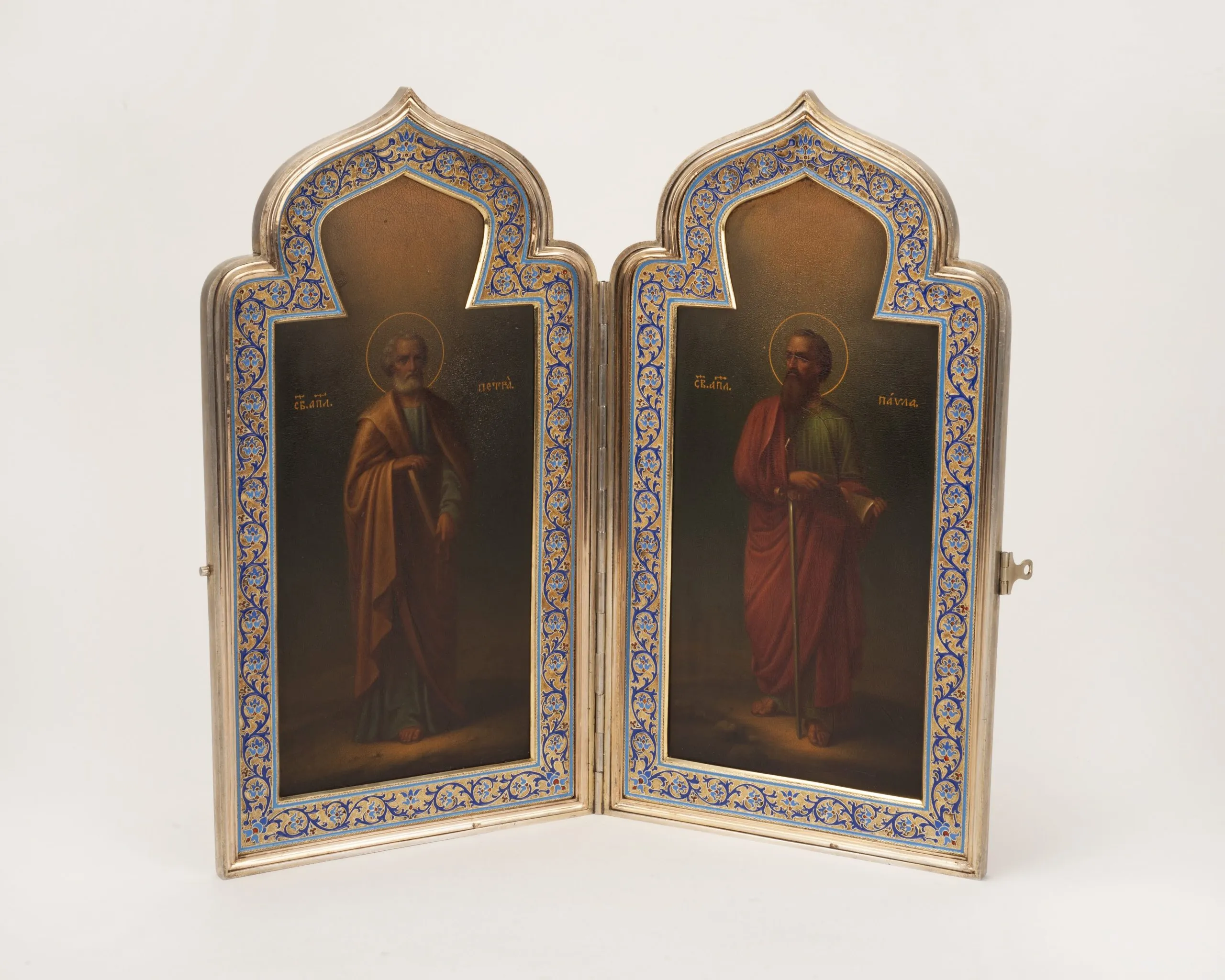
Diptych Icon of Apostles Peter and Paul (front). Firm of Grachev Brothers. St. Petersburg, ca. 1904
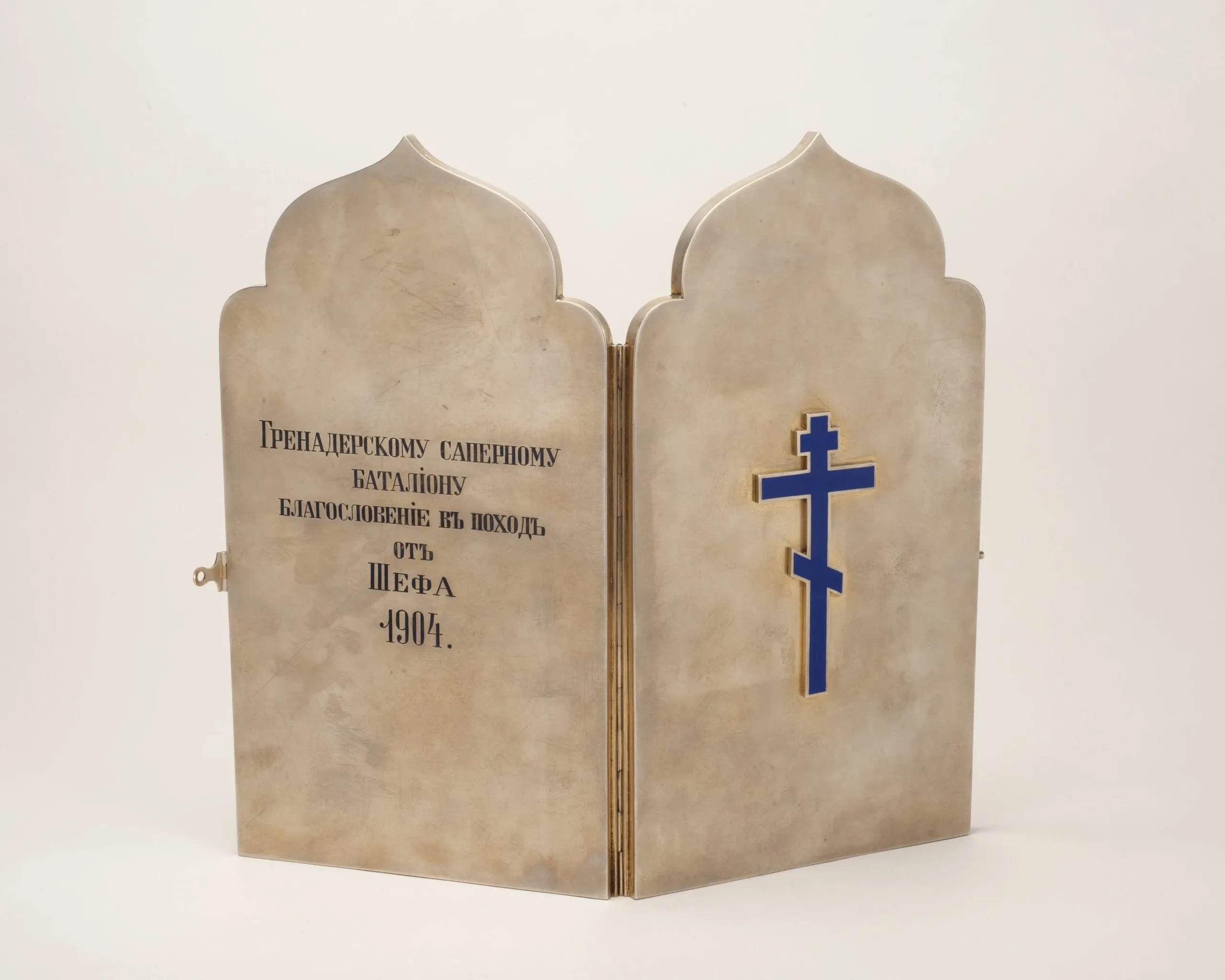
Diptych Icon of Apostles Peter and Paul (back). Firm of Grachev Brothers. St. Petersburg, ca. 1904
An inscription on this folding icon reveals its Romanov provenance. The simple silver cover is adorned with a blue enamel three-bar cross and the following dedication: “To the Grenadier Sapper Battalion, a blessing from the Chef, 1904.” The interior of the diptych reveals a further clue to its origin—a pair of icons depicting the Apostles Peter and Paul, each surrounded by a scrollwork cloisonné enamel border, executed by the Firm of Grachev Brothers in Saint Petersburg.
In 1905, the Grenadier Sapper Battalion’s chef, i.e. honorary commander, was Grand Duke Peter Nikolaevich, grandson of Nicholas I. (His older brother, Grand Duke Nikolai Nikolaevich the Younger, was appointed Commander-in-Chief of the Russian Imperial Army at the start of World War I.)
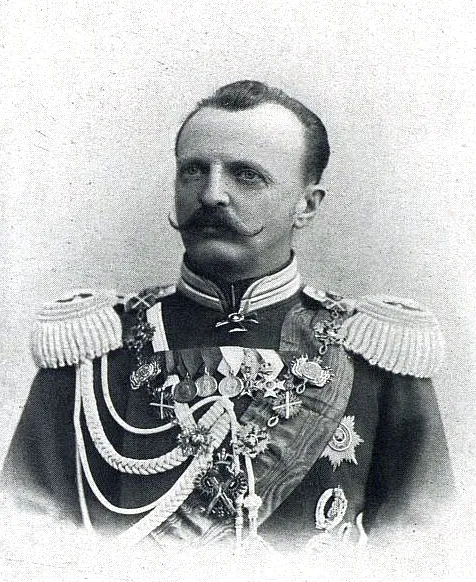
Grand Duke Peter Nikoalevich. Source: Wikipedia.org
The year of the inscription coincides with the Russo-Japanese War, when the battalion was deployed to Manchuria. Featuring the chef’s patron saint, this diptych was doubtless commissioned by Grand Duke Peter as a gesture of support and encouragement for the officers and soldiers of the battalion under his patronage. The choice of a folding diptych was practical, given the realities of an itinerant campaign life—the hinged panels protected the icons and could be opened at an angle that allowed for placement on any flat surface.
The icon was donated to the Russian History Museum by Irina Sergeevna Baline, daughter of Sergei Mikhailovich Vasiliev, an officer who served in the Grenadier Sapper Battalion.
4. Annunciation Icon from “Anastasia”
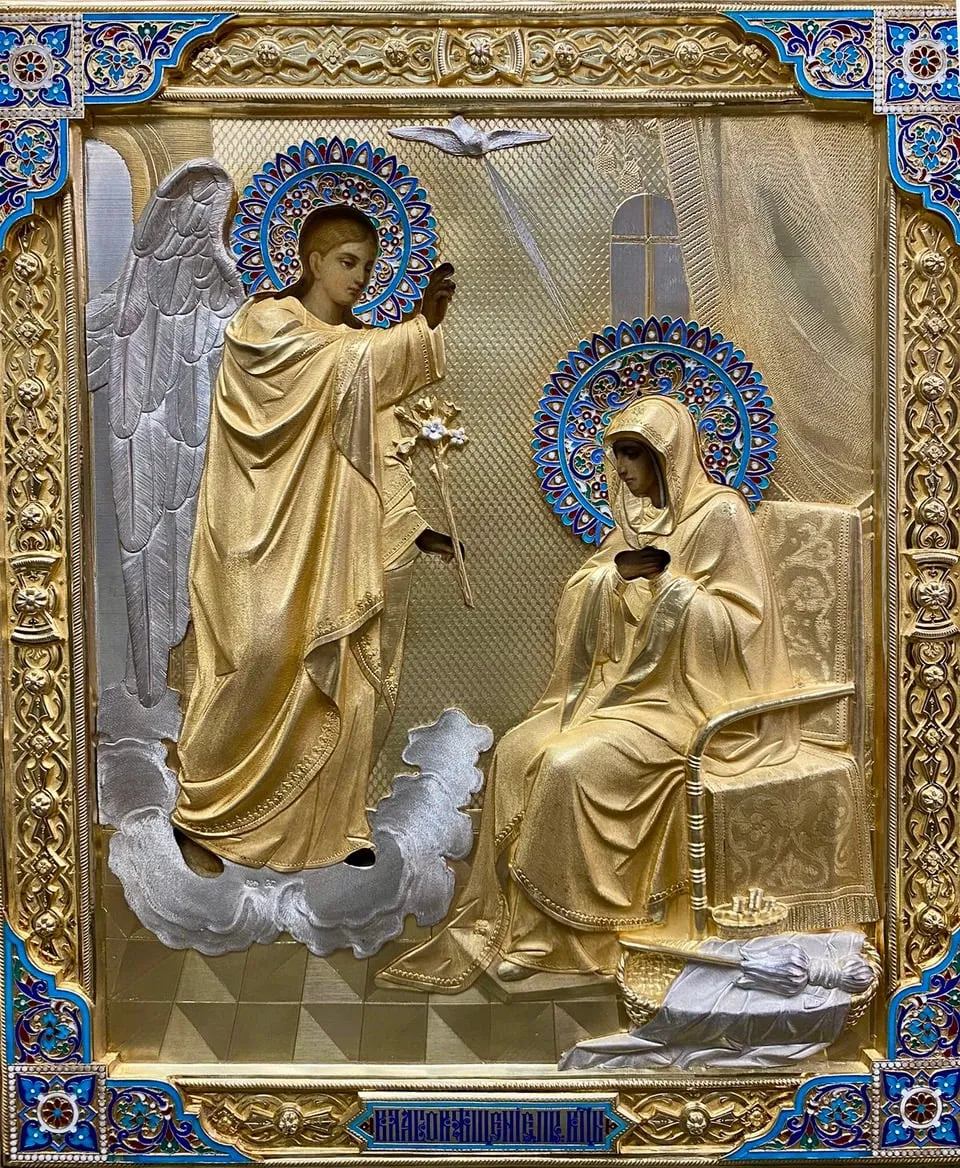
Icon of the Annunciation. Firm of S.G. Galkin & Co. Moscow, c. 1893
This icon of the Annunciation deserves attention not only because of its sumptuous cover, but also its intriguing backstory referencing the death of Nicholas II and his family. It was created in Moscow in 1893 by the well-known silversmith Semyon Grigorievich Galkin. In 1892, he founded the firm S.G. Galkin & Co., the icon’s cover features an almost painterly interplay of silver and two kinds of gilding, as well as the trompe l’oeil engraving that simulates the patterned stone floor, the layering of clouds, and even the distaff of weaving material by the Virgin Mary’s side. The use of enameled corner pieces and halos introduces even more texture and color to the oklad.
The full effect of the combination of various techniques and materials became evident after the icon cover was cleaned in 2021. Decades of oxidation and discoloration were painstakingly removed to bring the icon back to life.

The icon was a gift to the museum from Eugenia Smith, who is better known to the world as one of the claimants to be Grand Duchess Anastasia Nikolaevna, the youngest daughter of Nicholas II. According to the naturalization papers filed when she emigrated to the United States, she was born Eugenia Drabek on January 25, 1899 in Bukovina, Austria-Hungary, but would later claim in her “Autobiography of HIH Anastasia Nicholaevna of Russia” (1963) that she had escaped the murders at Ekaterinburg. In later years, she became a strong supporter of our museum, and left a number of objects to the collection, including this icon.
5. Prominent Bishops’ Accessories

Metropolitan Anthony’s Mitre. Russia, early 20th century
The Russian History Museum’s loans to the exhibition are not limited to icons. Two other examples of exquisitely crafted religious artifacts include objects symbolic of a bishop’s rank: a mitre and a crosier.
The mitre is executed in the Art Nouveau style popular at the beginning of the 20th century. Icons depicting Christ, the Virgin Mary, St. John the Baptist, and Calvary adorn it on four sides. Allegedly the mitre belonged to Metropolitan Anthony (Khrapovitsky) (1863-1936), a distinguished hierarch and theologian who became the head of the Russian Orthodox Church Outside Russia following the Russian Civil War.
The crosier, or bishop’s staff, also belonged to an eminent hierarch of the Russian Orthodox Church. Prior to the revolution, Archbishop Anastassy (Gribanovsky) was tasked with serving in some of Moscow’s most ancient and notable churches and monasteries, such as the Kremlin’s Dormition Cathedral, and participating in the planning of important commemorations and ceremonies (i.e. the 100th anniversary of the Battle of Borodino; the tercentenary of the Romanov Dynasty; and, in 1917, the installment of Patriarch Tikhon – the first patriarchal enthronement since the reign of Peter the Great).
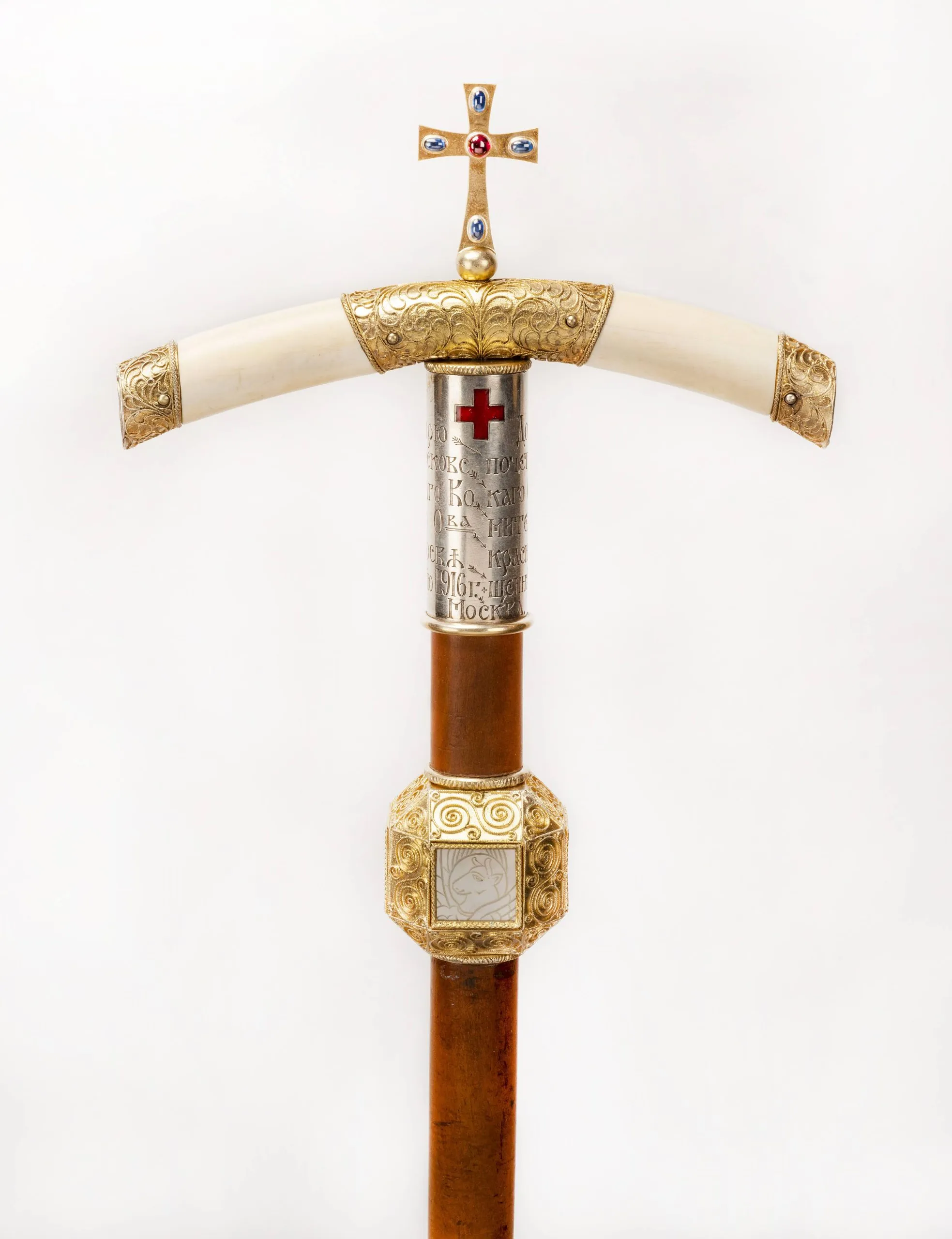
Bishop's staff/Crosier. Kuzma Konov. Moscow, ca. 1916
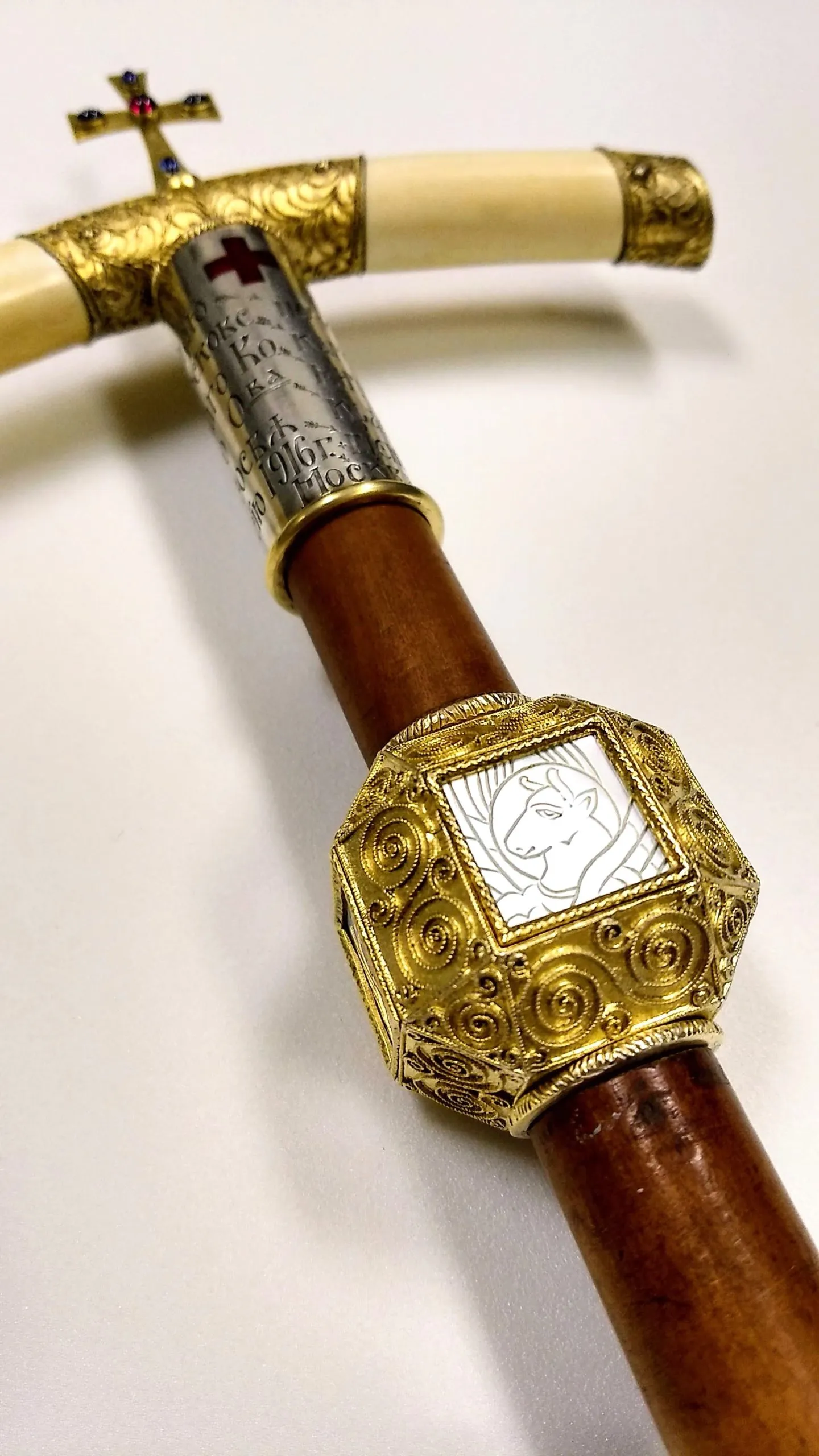
Bishop's staff/Crosier. Kuzma Konov. Moscow, ca. 1916
The crosier is made of wood, ivory, filigree, enamel, gilt silver, and mother-of-pear. Marked with the maker’s initials “K.K.,” it is most likely the work of silversmith Kuzma Konov, who developed a unique style referencing both ancient Byzantine and Russian models as well as Art Nouveau influences.
The top section is decorated with filigree ornaments and four mother-of-pearl insets with symbols of the four Evangelists. The addition of a red enamel cross and a presentation inscription points to Bishop Anastassy’s contribution to relief efforts during World War I: “To the beloved pastor and honorary member of the Moscow Seraphim Committee of the Russian Society of the Red Cross, the Right Reverend Anastassy, 1916. Moscow.”
Upon leaving Russia in the wake of the Civil War, Archbishop Anastassy continued to be actively involved in church administration, eventually becoming Metropolitan Anthony’s successor as the First Hierarch of the Russian Orthodox Church Outside Russia in 1936. The crosier must have accompanied him throughout his ministry, as we encounter it in a photograph of Archbishop Anastassy at a memorial service in Belgrade from the mid-1930s.
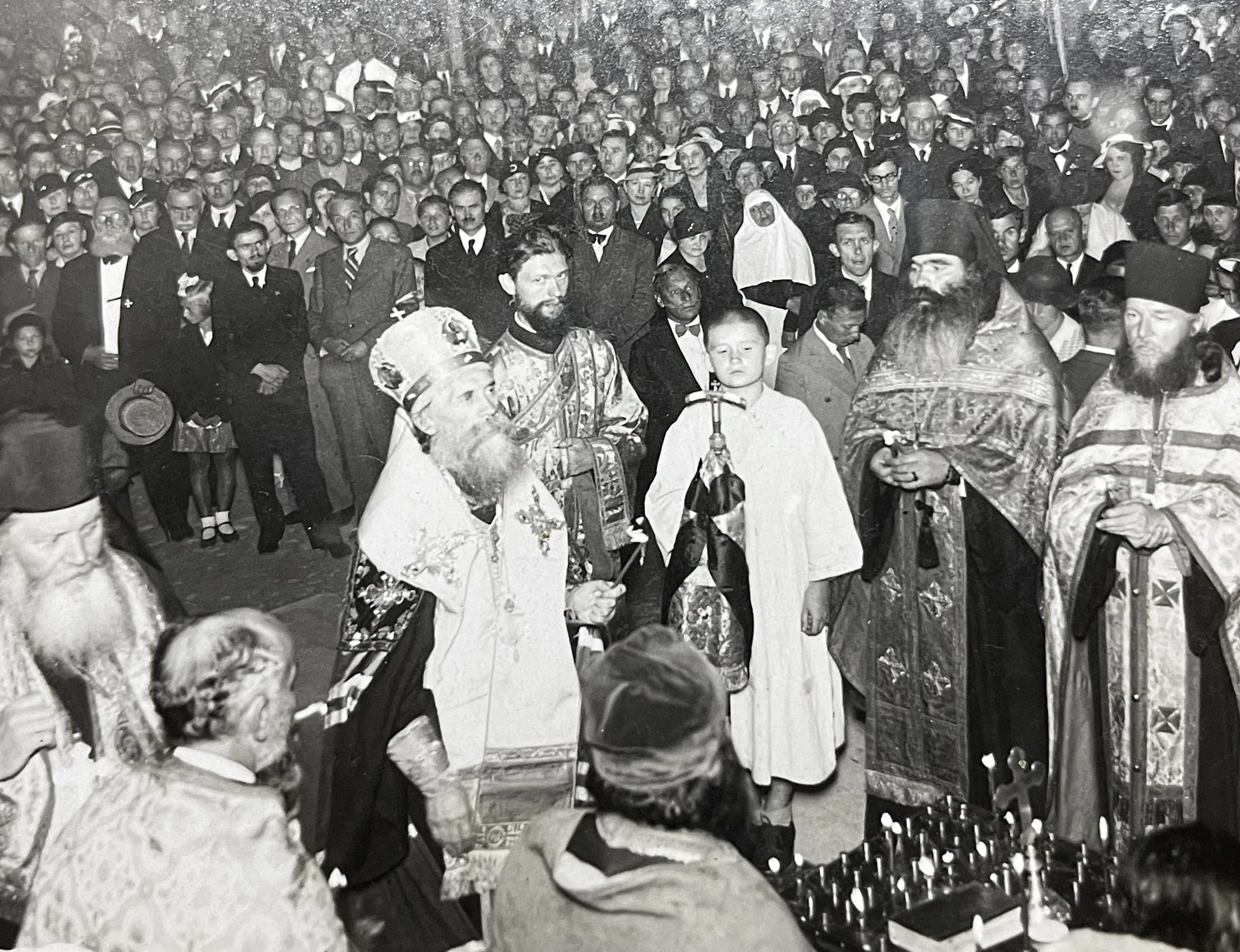
Archbishop Anastassy (Gribanovsky) at a memorial service in Belgrade, ca. 1936


